In many of my earlier posted recipes, I gave instructions or guidelines about how to choose ingredients for the recipes. However since I use many items frequently in other recipes, it can be difficult to find the information for making subsequent recipes that feature those same ingredients. Therefore in these next two posts I will outline what I look for in a variety of ingredients. As a general rule I try to choose the highest quality options that fit into my budget, as I outlined in earlier posts. The major food categories I will discuss are chicken, pork, beef, fish, stock, spices and alcohol or liqueurs, divided into two posts. This post contains some material lifted from earlier posts added with new material.
When possible, avoid ordinary supermarket chicken. First, because they are water-chilled, you are paying for water and more importantly there is a much greater risk of salmonella contamination than when chicken is air-chilled. Second, the cheapest chickens are so priced because they are raised in truly horrible conditions. They live jammed together, are fed food of questionable origin and are more prone to diseases. There is a very good TV special hosted by Jamie Oliver where he exposes the practices of chicken farmers. Finally, higher quality chickens tend to have better flavour. Obviously, free-range organic is the best choice but can be pricey. A decent compromise would be to buy chickens that are fed 100% vegetable grain. Another budget option can be Kosher chicken. The chickens have to meet higher standards of health and, because the process of Koshering involves soaking the chicken in a salt solution, the meat is more flavourful. Just be sure to use a little less salt if you use this chicken. Depending on where you live, a similar acceptable option may be Halal chicken, which I believe follows many similar processes. The difference is not all halal meat has official certification whereas all kosher food is certified by a recognized agency. If the halal chicken is from a certified halal provider then that is also an option.
Many people do not realize this, but many of the same problems I just identified with chicken farming apply to pig farming as well. Many of the factory farms keep the pigs in pens at all times, much like milk-fed veal, which I generally avoid in favour of grain-fed veal. The conditions are atrocious and this is why pig farms smell the way they do. Pigs raised in healthy and humane conditions do not stink. A recent development in pork production is the raising of “heritage breeds”, such as Berkshire (also called Kurobuta), Tamworth and others. These tend to have a more pronounced taste and, since they are farmed on a small scale and command a premium price, they are usually raised in more humane conditions. I don’t eat a lot of pork (partly due to my Jewish upbringing) so, when I do, it has to be good. My favourite pork products are cured items, such as bacon, salami, prosciutto, kielbassa and the like. Unfortunately, most of these products require the use of nitrites and/or nitrates to preserve them. Overconsumption of these chemicals has been linked to certain health problems so, it can sometimes be worth searching for products that only use sodium nitrate (curing salt) for preservation. Some traditional prosciutto and a few very dry cured sausages can be safely cured without any nitrates, but they are few and far between. And when you can find them, they are very expensive, because nitrate free products have to have a very high overall pH, which is usually accomplished through additional drying, which means more raw product is needed to produce the same amount of cured meat. Otherwise, just don’t eat too much of it. Cured pork tends to be high in salt anyway.
The beef you select has a lot to do with its intended use. Some cuts are better for slow cooking and others for quick searing. In my last post I told you in general terms that meat cut from more heavily used muscles are more flavourful but need longer, slower cooking times. For a stew, my favourite cuts are short ribs, bottom blade (from the shoulder) and cheek. If you want to make a pot roast or a similar slow cooked whole piece, brisket is the best for that. For steak, I prefer rib steak or rib eye (that is rib with the bone removed), but striploin and T-bone are good options. If you want something less expensive, top sirloin is a really good choice. Usually even cheaper is bottom sirloin (also called tri-tip) and flank steak, but these require some care. Flank steak should be marinated beforehand and either cut should be sliced across the grain of the meat to make sure the meat is tender when eaten. The grain is where all the visible muscle fibers on a piece of meat run in a uniform direction. You will see a bunch of ridges or grooves, most of them clearly going in the same direction. Cut thin slices across these grooves and the meat will pull apart tender. Many less expensive cuts of meat you will see in the store have the word “round” in their names (top round, bottom round, eye of round). Don’t bother with these. They are not tender and don’t have enough fat for good flavour. Finally, ground beef or hamburger meat. Your standard ground beef is made up of all the miscellaneous parts of the cow that can’t be sold as an individual cut of meat. Also if a butcher has more supply of one cut than they can sell, it will be ground into hamburger. The cheaper, mass produced hamburger uses all kinds of bits and pieces you probably don’t want to think about. Because they run so many different parts through the grinder and isn’t always very fresh, there is more risk of E. Coli contamination. If you buy preground and prepackaged hamburger meat it is not safe to cook it less than well done, an unfortunate situation for the quality of the finished product. So can a hamburger be safely cooked to medium or medium-rare? Yes, if you use the right meat under the right circumstances. Ideally, buy a whole cut of meat, such as chuck or blade and grind it yourself and use it right away. Obviously you need a meat grinder to do this. You may be able to do this in a food processor as well but the consistency will not be as good. If you have a quality butcher shop near you, you should be able to buy a cut of meat and have them grind it for you. The key element is that risk of contamination increases the longer the ground meat is exposed to the elements and if the grinder is not properly clean. This is why there is no risk to eating a rare steak, and little risk even for steak tartare, raw chopped meat, since it is hand chopped right before serving.
With all of these meats there is the issue of whether or not to buy organic. In general it is true that meat produced using organic methods are treated more humanely and taste better. However, quality meat does not necessarily have to be certified organic. The thing is, the requirements to be considered organic are quite stringent. Not only are the animals only allowed to be fed good food with no chemicals, antibiotics or hormones, but the source of all feed must be certified organic, which requires pure, organic, uncontaminated soil that remains so for several years. That means new, start-up farms can never be certified organic. And sometimes there are practices that do not meet the criteria of “organic” that are not necessarily an indication of unsustainable practices or inhumane treatment. The best thing to do I suppose is find out as much as you can about the source of your meat.
I don’t eat a lot of fish and seafood, so I don’t have much to say here. The main thing is that if you think you don’t like fish because of the “fishy” taste, you were probably eating old fish! Fresh fish should smell of nothing but the ocean. The problem is that fish is very perishable and not as popular in North America than other meats so fish often sits around longer than it should. Also, if you live in the middle of a large landmass, (like in the prairies or the midwest) fish has to be transported a long distance before even getting to the store. Just try to buy as local as possible and at a shop that sells a lot of fish. The other consideration is sustainability. Many of the most popular eating fish have been overharvested to the point where the numbers are decreasing at an alarming rate. Seafood Watch in the United States and Ocean Wise in Canada are programs that monitor global fish stocks and rates whether certain fish are still being caught in a sustainable manner or if they should be avoided. Many of the big deep sea fish are not caught in a sustainable manner and are to be avoided. The manner in which the fish are caught also factor into the ratings.
Wednesday, August 17, 2011

Tuesday, August 2, 2011
Ottawa Food Review - Part 2
I know it’s a little delayed, but here is the remainder of my reviews of the food from my trip to Ottawa last month. But first, as a follow-up to my last post, Randy, a fellow blogger has posted his own thoughts on the issue and it is well worth the read. Check it out at http://wordsthateffect.blogspot.com/2011/07/finally-finished-my-thoughts-on-sex.html
Ottawa Rib and Chicken Cook-off
The week I was in Ottawa was the week of Ottawa’s Rib and Chicken Cook-off which takes place on the Sparks Street Mall, an event I mentioned in an earlier post. Day two in Ottawa was a busy one , working to set up our event leaving only a short period of time for dinner. As our hotel was right on the western starting point of the Mall, we decided we would have dinner at the ribfest rather than finding a restaurant and waiting for who knows how long.

Ribfest is made up of several independent vendors and competitors mostly from the United States with a few Canadian entrants. This event is part of a competitive circuit of similar events throughout Ontario during the summer. The competitors here proudly displayed their wins at all these various competitions, including one that takes place right here in Guelph, which will take place this year from August 26-28 - and I will be there. Judges give awards for ribs, chicken, sauce and pulled pork, and some stalls provide additional offerings as well. Particularly during the weekend, the lines at the best stalls were very long but when we went there on Friday afternoon, it was raining steadily, keeping many of the crowd away. The stall we chose was actually the first one we came across, though we did check out the others on that first block. One reason for choosing this one was that the smoke smelled much better and sweeter than at some of the other competitors, where one had almost an acrid smell. Also this stall sold, in addition to chicken and pork, beef ribs, which is my mom’s favourite and also a selling point since one of us did not eat pork. Finally, this competitor was a Canadian outfit, based in Chatham, Ontario. So Blazin BBQ was our choice. Between the four of us who went, we ordered most of their offerings, and I made sure to try as much as possible, ordering their “mighty meat” combo, which contained pork ribs, beef ribs, and chicken. The orders also came with coleslaw and baked beans, the expected sides for true barbeque.
This was the best meal of the trip. The beef ribs were especially impressive, full of flavour and meltingly tender. The sauce, which I believe was the same on all the meats, was absolutely perfect. It was smoky sweet tomato based sauce in the Kansas City style. I am very picky about sauce, since I find most to be unpleasantly sweet and sticky. While sweet, this one was not too sweet and was a perfect match for the meat, which in every case had just enough smoke. Also the meat was not oversauced, a common failing of lesser barbeque. Some of this team’s highest accolades were for sauce, so I’m sure I am not alone in this opinion. The chicken was perfectly cooked. This was especially impressive since I know how hard it is to have chicken fully cooked yet still tender and juicy. The pork ribs were very tasty, though I would have preferred them to be just slightly more tender. Still, they were not at all chewy or tough, they came off the bone easily and completely. It may even be that in competitions, ribbers are cooking them less because judges now prefer ribs that do not fall off the bone - those that do are considered overcooked. The sides were certainly decent, though not as good as the meat. They were definitely good, but just like others I have had many times before - nothing special. But anyway, the sides seemed to be an afterthought to them, and that was the way we approached them too. The portions were large and the prices, though not especially cheap, were certainly reasonable given the portion size and quality. My companions had simply different combinations of the same things: either beef or pork ribs with chicken.
Restaurant Review - Really Lebanese Food
I am a little conflicted about including this review because I do have, on some level, a personal connection to this restaurant. A relative of mine is closely involved with the establishment, which means that it is hard, if not impossible, to be fully objective in reviewing this place. But I honestly do like the food and I feel that, as long as the reader is aware that I have a personal connection with the restaurant, the review can still be of use.
In part because of this family connection, our family event all went for lunch at this restaurant, a group of about 40+ people. Really Lebanese is a small strip mall shawarma restaurant in the east of Ottawa, on Montreal Road. They call themselves “home of the garlic king” a reference to their chef, Adel, the self-styled garlic king. The promotional methods they use are certainly over the top and some have criticized them for this, but it certainly attracts attention, which I would think is the purpose of self-promotion. And it seems to fit with Adel’s engaging and “out there” personality. He rides around in a customized van that has to be seen to be believed.
 Really, the picture doesn't quite do it justice. Oh, and that dome with the crown around it? That's the sunroof, so Adel can be on display, kind of like a popemobile.
I have been to Really Lebanese many times before, so my review will also be influenced by previous visits. The specialty is shawarma, a lebanese dish of spit-roasted seasoned chicken served in a pita with various condiments. It is somewhat similar in concept to the Greek gyro, but the seasonings, condiments and side dishes are different. While there are other offerings, including vegetarian ones, I must admit that the only thing I have ever ordered there is the chicken shawarma. You choose the size you want and can choose whatever you want from their array of condiments. My favourite is definitely the garlic sauce. It has a great creamy texture and, while it does taste intensely of garlic, it also has a certain mellowness. It is also available for sale in containers on site (at one time it used to also be sold at some Ottawa grocery stores but alas, no more). Another must have, other than your standard lettuce, tomato, cucumber, etc., is the pink pickled radish - excellent! The sides are a selections of typical lebanese offerings: hummus, tabbouleh, fatoush, and a chickpea salad. This group meal we had was originally intended to be a picnic in a park, catered by the restaurant, but because of weather we had to switch it to the restaurant. Because it was a large group, and we were running late, the meals had been prepared beforehand and set out waiting for us, which does affect the quality. Also, in my meal, the two salads I happened to get included neither of my favourites - the tabbouleh (theirs is the best I ever had) and hummus. Luckily my cousin, sitting next to me, did get those two sides and shared with me (thanks Max!). For dessert, there is a really good baklava and soft serve ice cream. Really Lebanese has been in business for many years, originally in a VERY small space in Orleans which used to be an eastern suburb of Ottawa and is now part of the amalgamated City of Ottawa. They moved to a larger location a few blocks away, and more recently to a still larger space on Montreal Road in the neighbourhood of Gloucester, still in the east end but closer to the centre of Ottawa than they were before. This is an exceptional place for lunch and a friendly environment.

Food Review - Delta Hotel and Suites Ottawa
Saturday night was a buffet prepared for our family group prepared by the hotel. I generally do not have great expectations for hotel buffets or large catered banquets. The food is usually bland and/or boring and often poorly cooked. What they gave us at the hotel, though, was rather good, considering the difficulties inherent in a buffet. There was a goat cheese and spinach salad that was quite decent and an orzo salad that was actually quite good. I almost decided to avoid this, because a pasta salad is usually something put on a buffet because it is “supposed” to be there. It is usually quite awful and is too often a repository for whatever is about to spoil and must be used. In this case the flavours were lively and the orzo was correctly cooked. The main courses suffered from the more common problems that plague buffets, but they were still rather decent. There was a salmon in a creamy sauce that was overcooked to my taste, though for some they considered it correctly cooked (it was not dried out). Also I found the sauce just a bit too salty. There was roast beef with a mushroom sauce. I was very apprehensive about the meat, as I prefer my meat medium rare I saw little prospect of that being achievable with meat sliced in advance and sitting in a steam table. Yet, when I selected the least cooked pieces they were at least medium, if not actually medium rare - a pleasant surprise. The sauce was excellent. The vegetables looked at first glance liked frozen mixed vegetables, but when tasting them they were too correctly cooked for that to be the case. Also there was also some small amounts of less traditional vegetables that do not appear in frozen packets, and these batches varied a little each time the chafing dish was refilled. The mashed potatoes, on the other hand, were bland and uninspired.
There was a marked variation in the quality of the dessert table, a must for private hotel functions. There was a great deal of variety, with several fruit-based tarts, cakes and squares, as well as fresh fruit. The desserts that had a pastry crust - the pies and tarts - were not very good as the crust was too tough. On the other hand, the cakes and squares were excellent. The sticky chocolate cake was probably the best, though a nicely spiced carrot cake ran a close second. The brownie-like dessert squares were also very good.
The overall success of this food, given the obstacles, I believe reflects very well on the overall quality of the hotel’s kitchen. We also had a brunch buffet at the hotel the next morning (this being the standard breakfast buffet for all guests) and that was very good as well. They make sure to keep the buffet stations constantly refilled and the food stays fresh. The smoked salmon was excellent (can’t tell if it was made in house or not - it could have been but there is excellent commercial product available too), the scrambled eggs were not overcooked and the bacon struck the right balance between chewy and crispy. It’s not like there was anything extra special - just the hotel breakfast standards. It was just well executed and care was taken. This is something often lacking in hotel buffets, so this was a welcome treat.
Restaurant Review - East India Company
We spent Sunday walking around Parliament Hill and the Byward Market, then all got together for dinner, in a group of about 11 or so people (don’t remember exactly). East India Company is an Indian restaurant (surprise!) on Somerset Ave. near Elgin street, in the south east end of downtown. This restaurant also features buffet service. I had been to this restaurant before many years ago when I was living briefly in Ottawa and even took part in a cooking class that they were offering. I remember that the food was fairly good then. The buffet featured a wide selections of the classics of Indian cuisine. One thing you will notice as soon as you enter, is the artwork and large decorative pieces that give the restaurant a very distinctive ambiance. Along one wall (where our table was), there is an intricate mural, which was built in India and shipped here at great expense.
The lamb curry was particularly good, as was the tandoori murgh (spicy chicken). The samosas and pakoras were a weak point, though I suppose I should have realized that small fried items are not at their best after sitting in a steam table. There was a good vegetarian dish, whose name I cannot seem to remember, that had vegetables in a creamy sauce, probably made with yoghurt. The butter chicken was also good and so was the chicken masala and lamb kofta (meatballs). Naan, Indian bread, costs extra but is very good, they also make excellent pappadums, a very thin flatbread that is more like a cracker and is wonderfully spiced. There is an extensive selection of pickles and chutneys as well. I’m not a big fan of these, but some of the chutneys, particuarly the mango, the coconut, and the tomato chutney were very good.
As for dessert, I really don’t like Indian desserts very much, the flavours and textures they tend to use are not really appealing to me. But judging from the opinions of others, some of the desserts were well received, including a mango mousse, a rice pudding, and the iconic Indian dessert, the gulab jamun, a specialty here.
The price is reasonable, twenty dollars per person.

Ottawa Rib and Chicken Cook-off
The week I was in Ottawa was the week of Ottawa’s Rib and Chicken Cook-off which takes place on the Sparks Street Mall, an event I mentioned in an earlier post. Day two in Ottawa was a busy one , working to set up our event leaving only a short period of time for dinner. As our hotel was right on the western starting point of the Mall, we decided we would have dinner at the ribfest rather than finding a restaurant and waiting for who knows how long.

Ribfest is made up of several independent vendors and competitors mostly from the United States with a few Canadian entrants. This event is part of a competitive circuit of similar events throughout Ontario during the summer. The competitors here proudly displayed their wins at all these various competitions, including one that takes place right here in Guelph, which will take place this year from August 26-28 - and I will be there. Judges give awards for ribs, chicken, sauce and pulled pork, and some stalls provide additional offerings as well. Particularly during the weekend, the lines at the best stalls were very long but when we went there on Friday afternoon, it was raining steadily, keeping many of the crowd away. The stall we chose was actually the first one we came across, though we did check out the others on that first block. One reason for choosing this one was that the smoke smelled much better and sweeter than at some of the other competitors, where one had almost an acrid smell. Also this stall sold, in addition to chicken and pork, beef ribs, which is my mom’s favourite and also a selling point since one of us did not eat pork. Finally, this competitor was a Canadian outfit, based in Chatham, Ontario. So Blazin BBQ was our choice. Between the four of us who went, we ordered most of their offerings, and I made sure to try as much as possible, ordering their “mighty meat” combo, which contained pork ribs, beef ribs, and chicken. The orders also came with coleslaw and baked beans, the expected sides for true barbeque.
This was the best meal of the trip. The beef ribs were especially impressive, full of flavour and meltingly tender. The sauce, which I believe was the same on all the meats, was absolutely perfect. It was smoky sweet tomato based sauce in the Kansas City style. I am very picky about sauce, since I find most to be unpleasantly sweet and sticky. While sweet, this one was not too sweet and was a perfect match for the meat, which in every case had just enough smoke. Also the meat was not oversauced, a common failing of lesser barbeque. Some of this team’s highest accolades were for sauce, so I’m sure I am not alone in this opinion. The chicken was perfectly cooked. This was especially impressive since I know how hard it is to have chicken fully cooked yet still tender and juicy. The pork ribs were very tasty, though I would have preferred them to be just slightly more tender. Still, they were not at all chewy or tough, they came off the bone easily and completely. It may even be that in competitions, ribbers are cooking them less because judges now prefer ribs that do not fall off the bone - those that do are considered overcooked. The sides were certainly decent, though not as good as the meat. They were definitely good, but just like others I have had many times before - nothing special. But anyway, the sides seemed to be an afterthought to them, and that was the way we approached them too. The portions were large and the prices, though not especially cheap, were certainly reasonable given the portion size and quality. My companions had simply different combinations of the same things: either beef or pork ribs with chicken.
Restaurant Review - Really Lebanese Food
I am a little conflicted about including this review because I do have, on some level, a personal connection to this restaurant. A relative of mine is closely involved with the establishment, which means that it is hard, if not impossible, to be fully objective in reviewing this place. But I honestly do like the food and I feel that, as long as the reader is aware that I have a personal connection with the restaurant, the review can still be of use.
In part because of this family connection, our family event all went for lunch at this restaurant, a group of about 40+ people. Really Lebanese is a small strip mall shawarma restaurant in the east of Ottawa, on Montreal Road. They call themselves “home of the garlic king” a reference to their chef, Adel, the self-styled garlic king. The promotional methods they use are certainly over the top and some have criticized them for this, but it certainly attracts attention, which I would think is the purpose of self-promotion. And it seems to fit with Adel’s engaging and “out there” personality. He rides around in a customized van that has to be seen to be believed.
 Really, the picture doesn't quite do it justice. Oh, and that dome with the crown around it? That's the sunroof, so Adel can be on display, kind of like a popemobile.
I have been to Really Lebanese many times before, so my review will also be influenced by previous visits. The specialty is shawarma, a lebanese dish of spit-roasted seasoned chicken served in a pita with various condiments. It is somewhat similar in concept to the Greek gyro, but the seasonings, condiments and side dishes are different. While there are other offerings, including vegetarian ones, I must admit that the only thing I have ever ordered there is the chicken shawarma. You choose the size you want and can choose whatever you want from their array of condiments. My favourite is definitely the garlic sauce. It has a great creamy texture and, while it does taste intensely of garlic, it also has a certain mellowness. It is also available for sale in containers on site (at one time it used to also be sold at some Ottawa grocery stores but alas, no more). Another must have, other than your standard lettuce, tomato, cucumber, etc., is the pink pickled radish - excellent! The sides are a selections of typical lebanese offerings: hummus, tabbouleh, fatoush, and a chickpea salad. This group meal we had was originally intended to be a picnic in a park, catered by the restaurant, but because of weather we had to switch it to the restaurant. Because it was a large group, and we were running late, the meals had been prepared beforehand and set out waiting for us, which does affect the quality. Also, in my meal, the two salads I happened to get included neither of my favourites - the tabbouleh (theirs is the best I ever had) and hummus. Luckily my cousin, sitting next to me, did get those two sides and shared with me (thanks Max!). For dessert, there is a really good baklava and soft serve ice cream. Really Lebanese has been in business for many years, originally in a VERY small space in Orleans which used to be an eastern suburb of Ottawa and is now part of the amalgamated City of Ottawa. They moved to a larger location a few blocks away, and more recently to a still larger space on Montreal Road in the neighbourhood of Gloucester, still in the east end but closer to the centre of Ottawa than they were before. This is an exceptional place for lunch and a friendly environment.
Food Review - Delta Hotel and Suites Ottawa
Saturday night was a buffet prepared for our family group prepared by the hotel. I generally do not have great expectations for hotel buffets or large catered banquets. The food is usually bland and/or boring and often poorly cooked. What they gave us at the hotel, though, was rather good, considering the difficulties inherent in a buffet. There was a goat cheese and spinach salad that was quite decent and an orzo salad that was actually quite good. I almost decided to avoid this, because a pasta salad is usually something put on a buffet because it is “supposed” to be there. It is usually quite awful and is too often a repository for whatever is about to spoil and must be used. In this case the flavours were lively and the orzo was correctly cooked. The main courses suffered from the more common problems that plague buffets, but they were still rather decent. There was a salmon in a creamy sauce that was overcooked to my taste, though for some they considered it correctly cooked (it was not dried out). Also I found the sauce just a bit too salty. There was roast beef with a mushroom sauce. I was very apprehensive about the meat, as I prefer my meat medium rare I saw little prospect of that being achievable with meat sliced in advance and sitting in a steam table. Yet, when I selected the least cooked pieces they were at least medium, if not actually medium rare - a pleasant surprise. The sauce was excellent. The vegetables looked at first glance liked frozen mixed vegetables, but when tasting them they were too correctly cooked for that to be the case. Also there was also some small amounts of less traditional vegetables that do not appear in frozen packets, and these batches varied a little each time the chafing dish was refilled. The mashed potatoes, on the other hand, were bland and uninspired.
There was a marked variation in the quality of the dessert table, a must for private hotel functions. There was a great deal of variety, with several fruit-based tarts, cakes and squares, as well as fresh fruit. The desserts that had a pastry crust - the pies and tarts - were not very good as the crust was too tough. On the other hand, the cakes and squares were excellent. The sticky chocolate cake was probably the best, though a nicely spiced carrot cake ran a close second. The brownie-like dessert squares were also very good.
The overall success of this food, given the obstacles, I believe reflects very well on the overall quality of the hotel’s kitchen. We also had a brunch buffet at the hotel the next morning (this being the standard breakfast buffet for all guests) and that was very good as well. They make sure to keep the buffet stations constantly refilled and the food stays fresh. The smoked salmon was excellent (can’t tell if it was made in house or not - it could have been but there is excellent commercial product available too), the scrambled eggs were not overcooked and the bacon struck the right balance between chewy and crispy. It’s not like there was anything extra special - just the hotel breakfast standards. It was just well executed and care was taken. This is something often lacking in hotel buffets, so this was a welcome treat.
Restaurant Review - East India Company
We spent Sunday walking around Parliament Hill and the Byward Market, then all got together for dinner, in a group of about 11 or so people (don’t remember exactly). East India Company is an Indian restaurant (surprise!) on Somerset Ave. near Elgin street, in the south east end of downtown. This restaurant also features buffet service. I had been to this restaurant before many years ago when I was living briefly in Ottawa and even took part in a cooking class that they were offering. I remember that the food was fairly good then. The buffet featured a wide selections of the classics of Indian cuisine. One thing you will notice as soon as you enter, is the artwork and large decorative pieces that give the restaurant a very distinctive ambiance. Along one wall (where our table was), there is an intricate mural, which was built in India and shipped here at great expense.
The lamb curry was particularly good, as was the tandoori murgh (spicy chicken). The samosas and pakoras were a weak point, though I suppose I should have realized that small fried items are not at their best after sitting in a steam table. There was a good vegetarian dish, whose name I cannot seem to remember, that had vegetables in a creamy sauce, probably made with yoghurt. The butter chicken was also good and so was the chicken masala and lamb kofta (meatballs). Naan, Indian bread, costs extra but is very good, they also make excellent pappadums, a very thin flatbread that is more like a cracker and is wonderfully spiced. There is an extensive selection of pickles and chutneys as well. I’m not a big fan of these, but some of the chutneys, particuarly the mango, the coconut, and the tomato chutney were very good.
As for dessert, I really don’t like Indian desserts very much, the flavours and textures they tend to use are not really appealing to me. But judging from the opinions of others, some of the desserts were well received, including a mango mousse, a rice pudding, and the iconic Indian dessert, the gulab jamun, a specialty here.
The price is reasonable, twenty dollars per person.
Saturday, July 23, 2011
A Moral Panic
Today’s topic may be a little more controversial than what I typically write, but I believe this topic is important. In the past couple weeks, a fellow blogger I respect a great deal, has been posting many stories and opinions regarding the way in which convicted sex offenders are treated in the United States. The reason for the interest is that there are recent laws coming into effect across the United States intended to create a uniform system and procedure for maintaining sex offender registries in all states. The original law is a federal law and states need to make new laws to be compliant with the federal regulations. The difficulty is that being on the registry makes it extremely difficult to get a job and the law also creates additional restrictions beyond those that already existed on where those on the registry may live (ie not near schools, playgrounds, etc.) The reason of course is to keep the public safe from potential predators, and to ensure that offenders continue to be monitored. To read a good selection of articles surrounding this issue visit Scottie’s Toy Box and scroll through. I have a link to his site on my sidebar or click here.
The point Scottie has been making is that this is extreme overkill and unnecessarily stigmatizes convicted sex offenders, making rehabilitation less likely. Also, many on the registry are either victims themselves or are not actually pedophiles or other sexual predators. He also claims that the public and the authorities seem to be putting more emphasis and severity of punishment on sexual abuse, than on other forms of abuse that can be just as damaging, if not more so. The post where he sets out his position on the issue can be found here (http://scottiestoybox.com/2011/07/03/injustice-for-all/) Scottie recently asked me for my opinion on this issue and I decided than, rather than spend lots of time composing a response to him that he would be able to post on his site, I thought that I should at least get a post of my own out of it. Scottie, you may reblog this post in the Toy Box if you wish, with a credit to me and a link back. While I must acknowledge I am not very familiar with the exact nature of the US laws on this issue, I would say that I mostly agree with the statement that the sex offender laws are not well thought out and, in some cases, seem to be overly punitive. Still there are some differences of opinion I will address later.
The biggest objection I have with what is happening is that all criminal offenses that are sexual in nature seem to require being placed on the registry. While the new rules do create tiers of offender depending on the severity of the crime, the only difference seems to be the length of time they must remain on the registry. Most people think sex offenders are pedophiles and rapists. The reality is that a surprisingly large percentage is people on the registry are youth, who may have been having sex while underage and the partner’s parents pressed charges. Or, since there is no allowance for young couples who are close in age, it is considered statutory rape if anyone over 18 has sex with someone under 18. This is a predicament that can potentially face anyone who is sexually active and does not share the same birthday as their partner (that would be most people). While I imagine that making laws uniform is intended to change this, people have ended up on a sex offender registry for public urination. Scottie has recently posted a story about 2 14-year old boys that pulled down their pants and sat on another boy’s face. While this is obviously bullying and unacceptable behaviour, possibly befitting criminal charges, an appeals court ruled that this was a sexual offense and as such, the boys would have to be placed on the sex offender registry for life. The point is that the judges seemed to indicate that this was overly harsh but the law gave them no alternative. On what planet does this make sense?
Another big problem I have is that placement on the registry seems to be allowed to factor into employment decisions. Honestly, unless the job is as a school teacher or child care worker, I don’t see how this is relevant in any way. And I can also understand that a job that requires an employee to be bondable would entail that the employee could not have a criminal record (usually), so there would be a problem in those instances as well. But there are so many industries that don’t require contact with children or other vulnerable people or require security clearances that this shouldn’t be an insurmountable barrier to employment. Yet employers won’t hire sex offenders and so many in the public seem to agree with this. But if society rejects you on a permanent basis, what incentive is there to obey the law and get on with your life?
This issue brings to mind a paper I wrote in a first-year university sociology class about moral panics. This is the short paragraph, exactly as I wrote it in that paper, that defines what a moral panic is - I think you will see how well it applies to the situation with sex offenders.
British sociologist Stanley Cohen, an acknowledged authority on moral panic, is credited with coining the phrase, although it actually made its first appearance in a colleague’s paper (Burns & Crawford, 1999; Thompson, 1999). Despite this technicality, it was Cohen who fully defined the term. In the classic definition, someone identifies an issue as a problem; it is reported in the media so as to influence the general public; the public develops an outrage against the issue; the authorities respond in some way; and the issue will finally either fade in importance or corrective action will be taken (Thompson, 1999). More recently, sociologists have attempted to specify the conditions that give rise to a moral panic (DeYoung, 1998). There has to be a pre-existing worry about the issue (DeYoung, 1998), and it must have the ability to create hostility among the public (Burns & Crawford, 1999). The media must be able to identify what Cohen calls a “folk devil”, a scapegoat upon which the public can easily place blame. These folk devils are very often marginalised members of the community (DeYoung, 1998).
One of the examples I had mentioned, though it was not central to the paper, was the allegation of satanic ritual sexual abuse in day care centres in the United States. In the 1980's there were claims that at least one (and later others) day care centre was sexually abusing children in their care using satanic symbolism. The only evidence was the claims of the children, many of whom were under 4 years old at the time and, even when questioned years later, were still young children. It later came out that these stories were all pure invention, but a large number of day care centres had come under suspicion and were shut down in the interim and forever casting suspicion upon their operators.
But looking at that definition above, I’m sure you can see how well our current hysteria regarding sex offenders fits the pattern. The pre-existing issue is obviously those cases of child abduction and molestation that make the news, everyone is outraged and demands horrendous penalties for the perpetrators and there has been a large quantity of legislative response, mostly ill-considered. This building of a moral panic is why you see so much of a push to have a public registry of sex offenders. While anyone who looks carefully will know that most registered sex offenders are not accused of a crime stemming from pedophilia, this is the offense most people imagine when discussing sex offenders. The actual occurrence of child abduction is very rare (although child sexual abuse is not - it is more often perpetrated by family and/or friends) but a whole variety of sexual indiscretions can result in mandatory registration, from brutal, violent rapes, to in some places, indecent exposure. Also, the part about the folk devils being marginalised members of the community is especially obvious here: the focus is exclusively on pedophiles, since adults having sexual desire for children is considered so revolting and incomprehensible to most people. These people also tend to have histories that involve abuse and neglect, meaning they are even further marginalised. Putting them on a “list” underscores this separateness from society and makes it easier to create laws that would be considered excessive and cruel for any member of the “normal” society. For this reason, I am strongly opposed to the way in which congress develops these laws. The laws are supposedly about all sexual offenses, yet they name these laws invariably after victims of child abduction (Adam Walsh, Megan Kanka, etc.) The way I see it, if there are so few victims of a particular crime you know all the names of the victims, is so much social and legal change really needed? In Ontario in the early 1990's there was a serial killer on the loose, raping women and abducting, abusing and killing girls. Eventually the perpetrator was found to be Paul Bernardo and his wife/girlfriend Karla Homolka. While some may argue that Homolka was not sufficiently punished (she testified against him, striking a deal for 12 years in prison and has already served the full sentence), Bernardo was rightly identified as a dangerous menace, was convicted of many charges. He received life in prison and was declared a dangerous offender, rendering him ineligible for parole. Because we have dangerous offender status and a somewhat lesser status of high risk offender, this means that if an individual is too dangerous and at too much risk to re-offend, we have methods to keep such people off the streets but only on a case by case basis, and it is not an easy designation to get. We also do have a sex offender registry, but it is not generally available to the public but only to the police. Maybe this is a better way to go, as there is still monitoring and tracking of potentially dangerous people, but does not have the high potential for vigilante justice as in the US where the registry is available to any member of the general public, some of whom have questionable motives.
Then there are the issues over which I disagree with my friend. First there is the nature of the crime and the prospects for rehabilitation. While it may be true that sex offenders, as a group, are the second least likely class of offenders to reoffend, I think this has a lot to do with grouping all kinds of tenuously related offences together, from child abuse, to young love, to rape, to a domestic dispute. Age of consent issues will of course not result in a re-offence, since once the “criminal” ages a bit, the crime can no longer be committed. For some who use force in sexual situations, therapy and rehabilitation is possible and effective. The same can be true when the crime happened as a result of substance abuse. So why is there an impression that sex offenders cannot be rehabilitated? Because some - those that get most of the press but make up a very small percentage of the offender population - commit crimes that are usually the result of a very serious compulsion for which an effective rehabilitation has not been found. Pedophiles are extremely likely to re-offend, as are some serial rapists. But even though they are a small percentage of all sex offenders, these are the most serious crimes in the category, and the fact that treatment and rehab is highly unlikely in these cases is a concern we need to take seriously. This is why the strict conditions, reporting requirements, and tight restrictions are in place. These people are known to be dangers and in all likelihood will remain so unless carefully monitored. Now, why every other sex offender is subject to all the same restrictions is beyond me, but that does not mean that we throw out the baby with the bathwater (is it inappropriate to use that phrase here? Oh, well). While this means convicted pedophiles are going to have a hard time finding a place to live and a good job, safety is a very real concern, and no they should not be working with kids if they have molested children before. And if they live near playgrounds and such, they will be too hard to keep track of and they will be too close to temptation. But for other sex offences that have no relation to children, especially for those who can be rehabilitated, I do agree that all those restrictions are draconian, not to mention pointless.
Finally, there is the issue of damage caused by sexual abuse as compared to other forms of abuse. I think the key thing to remember here is that everyone is their own individual and reacts to the events of their lives in different ways. Also, having not been abused myself, I don’t really have a frame of reference. Although from what little Scottie has shared with the reading public on his blog, I get the impression that the sexual abuse he suffered was not as extensive or painful. Also, something that I believe makes a bit of difference, he seems to suggest that those who abused him physically were more direct family members than those who committed the sexual abuse. I apologize if I got this wrong, and if it is, just take this as a theoretical example of someone else for whom this was the case. If someone very close, such as a parent, abuses you in ANY way, I would think that this abuse would have longer-lasting psychological effects, as there is also a deep betrayal of trust that goes along with the physical pain, guilt and/or shame suffered. For others, the sexual abuse could be worse. And while physical abuse may be more likely to cause long term health effects, the same thing can happen if a sexually transmitted disease is contracted as a result of a molestation. Several months ago I was following the blog of a young man who had been sexually abused by the father of one of his friends. Because of this, he contracted Hepatitis and HIV and died last winter. Sexual abuse can have horrific consequences as well, it is just a matter of what happened in each individual case.
To summarize, I think that the biggest problem with the manner in which sex crimes are dealt with in the United States is the failure to separate the more serious crimes from the less serious ones.
Monday, July 18, 2011
Restaurant Review - Vittoria Trattoria
Before starting this review, there is some blog news to share. The Writer’s Kitchen is now a featured blog on Restauranteers.com. Restauranteers is a restaurant and food blog that also collects a wide variety of food blogs with an amazingly wide variety of different topics. I was initially unsure about joining with the site as I also write about other topics, but decided to go ahead because they are looking for a diverse collection of blogs. This will introduce more readers to this blog. For those of you who are not foodies, don’t worry - this partnership does not mean I will only focus on food. The mix will stay similar to how it has always been. Check out the blogs they have to offer at http://blog.restauranteers.com/top-bloggers. There is also a new badge on my sidebar that will take you to their home page. Another change is that I have added a button for readers to subscribe to my RSS feed. My blog always had that func tionality, but now it is easier to grab my feed.
***************************************************************

My mom and I arrived in Ottawa a day earlier than originally planned so we could help her sisters, who were organizing our family event, with some setup tasks. The payoff for this was we were able to get together with a few early arrivals for a dinner in the Byward Market. The restaurant chosen was Vittoria Trattoria, a fairly well-regarded restaurant in the heart of the market. Since there were 10 of us for dinner I wasn’t really keeping track of what everyone on the table was having. The menu focuses on the neighbourhood Italian standards, with the expected antipasti, many pizza and pasta selections, and secondos such as veal, chicken, and lamb. To start, I ordered the mussels with grappa, raisins and pine nuts. The mussels were fine. I kind of liked the touch of pine nuts with mussels and the broth was excellent, and I believe the grappa was useful in allowing the mussel broth to be the primary flavour (as opposed to, say, wine). However, when I make mussels myself I always try to find the freshest possible and cook them immediately, so the mussels are usually exquisitely fresh. These, while they were absolutely not spoiled or obviously old, were not as supremely fresh as mussels can be. This is probably an unrealistic expectation in most restaurants though, so I will say I liked the starter.
I had veal marsala, an Italian classic, for my main course. The sauce was fairly good, but the meat could have been prepared better. Veal scallopini requires careful treatment to be sure it is at its best. This veal had a slightly pasty texture on the outside, likely a result of too much flour used to coat the veal before pan-frying. Also the veal was just a little tough. There could be a couple of reasons why this happened. First, the veal was probably overcooked. Second, veal scallopini is usually cut from the leg, a tough cut of veal. In order to make this a tender cut, you must cut very thin slices and then carefully pound the meat to make a very thin, wide piece. This may not have been pounded enough. The sides were decent but not excellent. Several in our party had pasta and, from what they said, the pasta was cooked perfectly and the sauces ranged from acceptable to very good. For dessert I had zuccotto, a layered cake and mousse based dessert. That was excellent and definitely the best part of the meal. Other desserts include a good tartufo and a less than stellar molten chocolate cake.
Some were impressed with the food but the majority opinion (including my own) was that the food was not excellent but certainly good. It can certainly be considered an average neighbourhood Italian restaurant. The problem is that, because Vittoria’s neighbourhood is the Byward Market, the prices are too high for the quality of the food. The main courses are in the upper 20 dollar range with the high end meats (veal chop, rack of lamb) well over 30. I did not order anything overly expensive and my meal still cost at least 50-60 dollars with ONE glass of wine, before the tip. I have read reviews other places that complain about poor service here, but when we were there, the service was good. Again I would not consider it superb but they were friendly and reasonably accommodating. The wine list is pretty good, with some affordable selections, several by the glass.

tionality, but now it is easier to grab my feed.***************************************************************

My mom and I arrived in Ottawa a day earlier than originally planned so we could help her sisters, who were organizing our family event, with some setup tasks. The payoff for this was we were able to get together with a few early arrivals for a dinner in the Byward Market. The restaurant chosen was Vittoria Trattoria, a fairly well-regarded restaurant in the heart of the market. Since there were 10 of us for dinner I wasn’t really keeping track of what everyone on the table was having. The menu focuses on the neighbourhood Italian standards, with the expected antipasti, many pizza and pasta selections, and secondos such as veal, chicken, and lamb. To start, I ordered the mussels with grappa, raisins and pine nuts. The mussels were fine. I kind of liked the touch of pine nuts with mussels and the broth was excellent, and I believe the grappa was useful in allowing the mussel broth to be the primary flavour (as opposed to, say, wine). However, when I make mussels myself I always try to find the freshest possible and cook them immediately, so the mussels are usually exquisitely fresh. These, while they were absolutely not spoiled or obviously old, were not as supremely fresh as mussels can be. This is probably an unrealistic expectation in most restaurants though, so I will say I liked the starter.
I had veal marsala, an Italian classic, for my main course. The sauce was fairly good, but the meat could have been prepared better. Veal scallopini requires careful treatment to be sure it is at its best. This veal had a slightly pasty texture on the outside, likely a result of too much flour used to coat the veal before pan-frying. Also the veal was just a little tough. There could be a couple of reasons why this happened. First, the veal was probably overcooked. Second, veal scallopini is usually cut from the leg, a tough cut of veal. In order to make this a tender cut, you must cut very thin slices and then carefully pound the meat to make a very thin, wide piece. This may not have been pounded enough. The sides were decent but not excellent. Several in our party had pasta and, from what they said, the pasta was cooked perfectly and the sauces ranged from acceptable to very good. For dessert I had zuccotto, a layered cake and mousse based dessert. That was excellent and definitely the best part of the meal. Other desserts include a good tartufo and a less than stellar molten chocolate cake.
Some were impressed with the food but the majority opinion (including my own) was that the food was not excellent but certainly good. It can certainly be considered an average neighbourhood Italian restaurant. The problem is that, because Vittoria’s neighbourhood is the Byward Market, the prices are too high for the quality of the food. The main courses are in the upper 20 dollar range with the high end meats (veal chop, rack of lamb) well over 30. I did not order anything overly expensive and my meal still cost at least 50-60 dollars with ONE glass of wine, before the tip. I have read reviews other places that complain about poor service here, but when we were there, the service was good. Again I would not consider it superb but they were friendly and reasonably accommodating. The wine list is pretty good, with some affordable selections, several by the glass.
Wednesday, July 6, 2011
A Visit To Ottawa
A little while ago I spent some time in Ottawa for a family event. Ottawa is Canada’s capital and has great things to see. There are some obvious sights to see and some others that are not as evident. As I have family in Ottawa, I have been there many times. The most exiting time was probably this past weekend, the Canada Day weekend. There are big celebrations on Parliament Hill and a festival in nearby Major’s Hill Park and of course fireworks shot from the Alexandria bridge that runs behind the Parliament Buildings. And this year the Royal couple - William and Kate - were in Ottawa for the event and the Queen was visiting the year before. I recall last year I posted about how sad and pathetic Montreal’s Canada Day celebrations seemed to be, and that had a lot to do with my memories of what this day is like in Ottawa. A modest parade seems inappropriate when you compare it to the massive celebration that takes place in Ottawa.
If you recall my posts about my trip to Washington D.C. last year, I made a point of not mentioning any of the most popular tourist attractions, mostly steering clear of the National Mall. Ottawa is a different matter, as I am Canadian and this is the capital of MY country. That is why my first recommended sight to see in Ottawa is Parliament Hill. This is the home of Canada’s government and is an iconic image for the country. Tours of the Parliament Buildings can be taken free of charge and you may even see Canada’s government in action (or whatever it is they are doing). In the centre of Parliament Hill is the Centennial flame. This fountain was constructed as a project to mark the 100th anniversary of Canada in 1967 and consists of a fountain with a gas flame constantly burning since it was first lit in 1966 coming up from the centre.
There are various other things to see that relate to Canada’s government, some more interesting than others. Some places worth a visit may include the Supreme Court of Canada or Rideau Hall, the residence of the Governor General. Canada is part of the British Commonwealth and, as such, Queen Elizabeth II of England is still our head of state, though all state functions are handled by the Governor General, who is appointed by the Prime Minister. Regular tours of Rideau Hall are available and the grounds are also worth visiting. There are many trees on the walk up to the house, planted by various dignitaries from around the world, including John and Jackie Kennedy, Nelson Mandela and many Royals. The most recent tree planting was last weekend by William and Kate, the Duke and Duchess of Cambridge.
There are several museums in Ottawa as well, and probably two of the more worthwhile are the National War Museum and the Canadian Museum of Civilization. The War Museum is Ottawa’s newest museum, built about 5 years ago on contaminated land that had to be cleaned up at great effort and expense. In keeping with the decontamination project, the building was designed with sustainablility and energy efficiency in mind. It even has a “green roof” so that the building is returning clean air to the environment. In addition, the shape of the museum is reminiscent of an army bunker and on a wing of the roof, there are a series of windows that spell out the message “Lest We Forget” in Morse Code.


The museum of Civilization is very hard to completely describe. It tells the social history of the people of Canada. There are often exhibits relating to native peoples and to specific ethnic groups. There is also a Children’s Museum that teaches kids about Canada and the world with lots of activities and fun stuff. Even kids that don’t like museums will like this, because it is almost as much play centre as museum. There is also an IMAX theatre. This museum is located across the river in Gatineau, Quebec. The grounds have an amazing view of the Parliament buildings, which sit directly across the river.
Back on the Ontario side is the National Gallery of Canada. This is Canada’s premier art gallery and houses many masterworks and travelling exhibits. On this most recent trip I found something fascinating just outside the entrance to the gallery. It is a piece of public art entitled “Maman” (French for “mother”). It is a 30 foot tall spider made of cast bronze, complete with an egg sac containing 26 pieces of white marble to represent her eggs. The artist did in fact use her own mother as inspiration for the piece, which raises some rather disturbing questions. Supposedly the piece is intended to evoke the fierce protectiveness of a mother but also a sense of entrapment. I guess she had some “mommy issues” to work out.

Another strange piece of sculpture nearby is located beside the United States Embassy, an imposing and rather unattractive behemoth of a building on Sussex drive. The sculpture, pictured below, is called “Conjunction” and supposedly represents the close ties between Canada and the United States and “a joining of individual parts into a coherent and unexpected whole”. Maybe I’m just uneducated about the finer points of interpretive art but to me this just looks like a bunch of metal welded together with no coherent purpose and just looks ugly and pointless. That is certainly not the image one would likely want to evoke when celebrating the bonds between our two countries. Well, take a look and see what you think. Maybe it really is a work of genius and I’m just some philistine.
In this same area is one of my favourite places in Ottawa. For regular readers, it should come as no surprise that this place is yet another public market. In some ways, the Byward Market is much like other markets that I love and visit regularly, wherever I happen to be. But in Ottawa, the market encompasses more than just the market building and surrounding vendor stalls. Like at Jean-Talon in Montreal, there are permanent stores selling meats, cheeses and other food-related items. But the Byward Market distinguishes itself by also housing the largest concentration of bars and restaurants in the city. Some of the city’s most vibrant and interesting restaurants are located here, as are more pedestrian offerings. I will be writing an upcoming review post of my dining experiences during this trip, including one restaurant in the Market. There are also upscale boutiques for those who love shopping for fashions (at least I assume these stores are good - not really my area of expertise). As for the market itself, the volume of offerings cannot compare to Jean-Talon, but I would compare it favourably with Eastern Market, which I visited in Washington D.C. last year and it is also better than most of the markets in my local area. So I suppose this would likely make it one of the better markets I know of.
There are many festivals in Ottawa. Aside from Canada Day there are many must-see events. The city goes all-out for the Tulip Festival in April. Like most other cities, there are jazz and blues festivals during the summer. While these pale in comparison to Montreal’s, especially when it comes to size and enthusiasm, they still attract good performers and make for an enjoyable activity should you happen to be in the city at the time. A block from the Parliament Buildings, the Sparks Street Pedestrian Mall has some noteworthy festivals, including a Busker Festival (buskers = street performers) and a rib and chicken cook-off (more on that in the restaurant review post). Though Canada is not often seen as an attractive tourist destination in the winter, February’s Winterlude is an event not-to-be-missed. Once the weather gets cold enough, the Rideau Canal is transformed into the world’s longest skating rink. Some people who work downtown will use the canal to commute to work on skates while the skateway is open.
In summer, the Canal is impressive too. You can take a boat tour along the canal or go from the start of the canal and take a tour along the Ottawa river. You can visit the locks at the entrance to the canal and, if a boat happens to be coming through, you can watch the canal in action as the locks are raised and lowered to move the ships through. In the same area is the Bytown museum, which tells the story of Ottawa’s early history. There is also the Chateau Laurier, one of Ottawa’s oldest luxury hotels. The hotel was financed by Canada’s railway, headed at the time by an American businessman. When the hotel was scheduled to be opened in 1912, this man was returning to North America to open the hotel but happened to be crossing on the Titanic and he did not survive. It is said that the 5th floor of the hotel is haunted to this day.
One attraction in Ottawa somewhat off the beaten track is the RCMP Musical Ride at the RCMP Stables in the neighbourhood of Rockliffe. This is a contingent of the Royal Canadian Mounted Police (Canada's federal police force) that displays the RCMP's tradition of precision horsemanship. They execute very difficult coordinated manoeuvres set to music. The musical ride spends a lot of time touring the country performing at fairs and equestrian events, so they only perform a few times a year in Ottawa at the stables but whenever they do perform, such as last week when I was there, it always draws a large appreciative crowd.

In an upcoming post (or posts) I will publish some reviews of restaurants I ate at during this stay in the nation's capital. I realize I have not been posting much since I left Montreal, but living at home has altered my schedule more than I thought it would. I am now trying to make time dedicated to writing so I hope you should see more posts. There have also been some recent developments on the food side of my blog and, once they are official, I will be able to tell you about them.
If you recall my posts about my trip to Washington D.C. last year, I made a point of not mentioning any of the most popular tourist attractions, mostly steering clear of the National Mall. Ottawa is a different matter, as I am Canadian and this is the capital of MY country. That is why my first recommended sight to see in Ottawa is Parliament Hill. This is the home of Canada’s government and is an iconic image for the country. Tours of the Parliament Buildings can be taken free of charge and you may even see Canada’s government in action (or whatever it is they are doing). In the centre of Parliament Hill is the Centennial flame. This fountain was constructed as a project to mark the 100th anniversary of Canada in 1967 and consists of a fountain with a gas flame constantly burning since it was first lit in 1966 coming up from the centre.
 The Centennial Flame - the construction going on in the background is the setup for Canada Day
 Parliament Buildings seen from the back. Pic was taken on grounds of the Museum of Civilization (see below)
There are various other things to see that relate to Canada’s government, some more interesting than others. Some places worth a visit may include the Supreme Court of Canada or Rideau Hall, the residence of the Governor General. Canada is part of the British Commonwealth and, as such, Queen Elizabeth II of England is still our head of state, though all state functions are handled by the Governor General, who is appointed by the Prime Minister. Regular tours of Rideau Hall are available and the grounds are also worth visiting. There are many trees on the walk up to the house, planted by various dignitaries from around the world, including John and Jackie Kennedy, Nelson Mandela and many Royals. The most recent tree planting was last weekend by William and Kate, the Duke and Duchess of Cambridge.
 Rideau Hall
There are several museums in Ottawa as well, and probably two of the more worthwhile are the National War Museum and the Canadian Museum of Civilization. The War Museum is Ottawa’s newest museum, built about 5 years ago on contaminated land that had to be cleaned up at great effort and expense. In keeping with the decontamination project, the building was designed with sustainablility and energy efficiency in mind. It even has a “green roof” so that the building is returning clean air to the environment. In addition, the shape of the museum is reminiscent of an army bunker and on a wing of the roof, there are a series of windows that spell out the message “Lest We Forget” in Morse Code.


The museum of Civilization is very hard to completely describe. It tells the social history of the people of Canada. There are often exhibits relating to native peoples and to specific ethnic groups. There is also a Children’s Museum that teaches kids about Canada and the world with lots of activities and fun stuff. Even kids that don’t like museums will like this, because it is almost as much play centre as museum. There is also an IMAX theatre. This museum is located across the river in Gatineau, Quebec. The grounds have an amazing view of the Parliament buildings, which sit directly across the river.
Back on the Ontario side is the National Gallery of Canada. This is Canada’s premier art gallery and houses many masterworks and travelling exhibits. On this most recent trip I found something fascinating just outside the entrance to the gallery. It is a piece of public art entitled “Maman” (French for “mother”). It is a 30 foot tall spider made of cast bronze, complete with an egg sac containing 26 pieces of white marble to represent her eggs. The artist did in fact use her own mother as inspiration for the piece, which raises some rather disturbing questions. Supposedly the piece is intended to evoke the fierce protectiveness of a mother but also a sense of entrapment. I guess she had some “mommy issues” to work out.

 Take note of the scale of this sculpture in both pictures. I tried to make sure there were people or cars in the frame to give some indication of the size. In the second picture, I just thought it was an interesting composition. The church is the largest and most ornate in Ottawa
Another strange piece of sculpture nearby is located beside the United States Embassy, an imposing and rather unattractive behemoth of a building on Sussex drive. The sculpture, pictured below, is called “Conjunction” and supposedly represents the close ties between Canada and the United States and “a joining of individual parts into a coherent and unexpected whole”. Maybe I’m just uneducated about the finer points of interpretive art but to me this just looks like a bunch of metal welded together with no coherent purpose and just looks ugly and pointless. That is certainly not the image one would likely want to evoke when celebrating the bonds between our two countries. Well, take a look and see what you think. Maybe it really is a work of genius and I’m just some philistine.
 Brilliant or ridiculous? Comment and tell me what you think.
In this same area is one of my favourite places in Ottawa. For regular readers, it should come as no surprise that this place is yet another public market. In some ways, the Byward Market is much like other markets that I love and visit regularly, wherever I happen to be. But in Ottawa, the market encompasses more than just the market building and surrounding vendor stalls. Like at Jean-Talon in Montreal, there are permanent stores selling meats, cheeses and other food-related items. But the Byward Market distinguishes itself by also housing the largest concentration of bars and restaurants in the city. Some of the city’s most vibrant and interesting restaurants are located here, as are more pedestrian offerings. I will be writing an upcoming review post of my dining experiences during this trip, including one restaurant in the Market. There are also upscale boutiques for those who love shopping for fashions (at least I assume these stores are good - not really my area of expertise). As for the market itself, the volume of offerings cannot compare to Jean-Talon, but I would compare it favourably with Eastern Market, which I visited in Washington D.C. last year and it is also better than most of the markets in my local area. So I suppose this would likely make it one of the better markets I know of.
 The main market building
 Streets in the Byward Market are lined with restaurants and, like this one, pubs
There are many festivals in Ottawa. Aside from Canada Day there are many must-see events. The city goes all-out for the Tulip Festival in April. Like most other cities, there are jazz and blues festivals during the summer. While these pale in comparison to Montreal’s, especially when it comes to size and enthusiasm, they still attract good performers and make for an enjoyable activity should you happen to be in the city at the time. A block from the Parliament Buildings, the Sparks Street Pedestrian Mall has some noteworthy festivals, including a Busker Festival (buskers = street performers) and a rib and chicken cook-off (more on that in the restaurant review post). Though Canada is not often seen as an attractive tourist destination in the winter, February’s Winterlude is an event not-to-be-missed. Once the weather gets cold enough, the Rideau Canal is transformed into the world’s longest skating rink. Some people who work downtown will use the canal to commute to work on skates while the skateway is open.
In summer, the Canal is impressive too. You can take a boat tour along the canal or go from the start of the canal and take a tour along the Ottawa river. You can visit the locks at the entrance to the canal and, if a boat happens to be coming through, you can watch the canal in action as the locks are raised and lowered to move the ships through. In the same area is the Bytown museum, which tells the story of Ottawa’s early history. There is also the Chateau Laurier, one of Ottawa’s oldest luxury hotels. The hotel was financed by Canada’s railway, headed at the time by an American businessman. When the hotel was scheduled to be opened in 1912, this man was returning to North America to open the hotel but happened to be crossing on the Titanic and he did not survive. It is said that the 5th floor of the hotel is haunted to this day.
One attraction in Ottawa somewhat off the beaten track is the RCMP Musical Ride at the RCMP Stables in the neighbourhood of Rockliffe. This is a contingent of the Royal Canadian Mounted Police (Canada's federal police force) that displays the RCMP's tradition of precision horsemanship. They execute very difficult coordinated manoeuvres set to music. The musical ride spends a lot of time touring the country performing at fairs and equestrian events, so they only perform a few times a year in Ottawa at the stables but whenever they do perform, such as last week when I was there, it always draws a large appreciative crowd.

 It's hard to really show the skill in the musical ride with still photos. But these should still give you some idea of what they do.
In an upcoming post (or posts) I will publish some reviews of restaurants I ate at during this stay in the nation's capital. I realize I have not been posting much since I left Montreal, but living at home has altered my schedule more than I thought it would. I am now trying to make time dedicated to writing so I hope you should see more posts. There have also been some recent developments on the food side of my blog and, once they are official, I will be able to tell you about them.
Sunday, June 12, 2011
Jerk Chicken
Spring here in Canada has been colder and wetter than usual but it finally looks like summer is finally getting near. That means it's grilling season! When I was living in Montreal I did not have access to a barbeque but now living at home with my parents I have that option. This is a recipe I have been making for a long time. I got the basis of this recipe from David Rosengarten, one of the TV chefs from the early days of the Food Network, almost a decade ago. While you can modify the amount of heat to your tastes, this IS Jamaican Jerk, so it does need to have some heat to it.
Jerk Chicken
2-3 small chickens (approx. 3 lbs each)
1 ½ cups vegetable oil
1 bunch scallions (green onions) (at least six)
3 cloves garlic
1 small onion
1 inch piece grated ginger
3 fresh scotch bonnet (also known as habanero) chiles, seeds and veins removed OR
2-3 Tbsp scotch bonnet hot sauce OR
as much as you can stand of either
3 Tbsp red wine vinegar
1 ½ Tbsp brown sugar
2 Tbsp fresh thyme
1 Tbsp ground allspice
½ tsp ground cinnamon
½ tsp ground cloves
½ tsp grated nutmeg
1 ½ tsp salt
½ tsp pepper
1 ½ Tbsp tamarind paste
2 tsp molasses
1 Tbsp lime juice
zest of 2 limes
1/4 cup Jamaican rum
This recipe requires some time, planning and some mess, but is rather simple to prepare, despite the number of ingredients. The recipe is better with fresh chiles but will work well with a hot sauce made from scotch bonnet peppers that does not have much other flavourings. When working with the fresh chiles, it is recommended to wear gloves when removing the seeds and veins. Scotch bonnets, a variety of Habaneros, are among the hottest peppers on earth and if you put your hand up to your face or, god forbid, your eye, it will be most unpleasant. If you have particularly sensitive hands these peppers might even irritate your hands. There is far more heat in the seeds and the ribs or veins (the white parts attached to the side of the pepper) so it is best to remove these. The flesh has less heat and all the flavour, so if you want more heat, don’t add the seeds, just use more peppers.
Chop the onion and scallions very roughly and put them in a food processor with the oil, garlic and ginger and puree until there are only a few chunks left. Add the chiles and process again. Add the sugar, vinegar and thyme and pulse to combine. Then add the spices, followed by the remaining ingredients. I do this in stages rather than all at once so I can keep checking the flavour balance and whether there is enough heat. It should seem just a bit too spicy, as this is a marinade. It may not look overly attractive - in fact it will probably look like greenish, brownish sludge as you can see from the pictures. The importance is the taste, though. When the marinade is done, transfer it to a large mixing bowl and cut up the chickens.

In a previous post, I described how to cut up a whole chicken for frying. The instructions for this application are mostly the same, but I will post it again because now I also have pictures of the various steps. For this recipe it is even easier because there will only be 4 pieces per chicken - I am not dividing the leg into drumstick and thigh, each side of the breast will stay as a whole piece, and the wings will stay attached to the breast. So all I am doing is quartering a chicken and removing the backbone. To disassemble my chicken, I take the legs off first. Cut down between the leg and breast then push up on the thigh until the thighbone pops out of its joint. Then remove the leg by cutting along the ribcage and through the joint.

Then I cut down each side of the backbone to remove the back, leaving the whole breast.

Using a cleaver, I chop through the keel bone (the big thick bone running down the centre of the breast). Now we have a quartered chicken, plus the backbone, which can be frozen and saved to make chicken stock.

When the chickens are cut, use a knife to poke a bunch of holes in each chicken piece and, one by one, put each piece in the bowl of marinade. Now the only way to do this is to get messy. You will need to rub the marinade into each piece of chicken. Try to get some underneath the skin and inside any gaps in the meat.
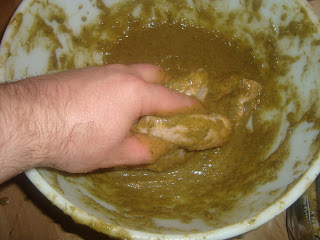
Divide the chicken pieces into 2 zip-top plastic bags, pouring the remaining marinade over the chicken. Distribute the marinade by massaging the chicken some more through the bag and let them marinate in the fridge for at least 24 hours. If you have time to do 48, even better.

Jerk chicken should be made on a barbeque. If you have a gas grill, set the heat on medium and let it come up to temperature. On a charcoal grill it will be a little harder to control the temperature but try not to let it get its hottest. Either way, it is very important to use wood chips to generate smoke. The best method is to soak either hickory, mesquite or fruit wood chips in water for 30-60 minutes, drain them and wrap them in foil pouches with lots of holes poked in them. Put the pouches directly on the heat source just before putting the chicken on. Cook for 20-30 minutes turning several times, or until the chicken is cooked.

Meanwhile prepare a sauce using the remainder of the marinade if you have enough. Add some water and rum and boil for at least 5 minutes so any bacteria is killed. Now if some of you are a little more nervous about salmonella, you may want to reserve some marinade before rubbing it into the chicken and use this instead. Serve the chicken with the sauce and rice as a side.


Jerk Chicken
2-3 small chickens (approx. 3 lbs each)
1 ½ cups vegetable oil
1 bunch scallions (green onions) (at least six)
3 cloves garlic
1 small onion
1 inch piece grated ginger
3 fresh scotch bonnet (also known as habanero) chiles, seeds and veins removed OR
2-3 Tbsp scotch bonnet hot sauce OR
as much as you can stand of either
3 Tbsp red wine vinegar
1 ½ Tbsp brown sugar
2 Tbsp fresh thyme
1 Tbsp ground allspice
½ tsp ground cinnamon
½ tsp ground cloves
½ tsp grated nutmeg
1 ½ tsp salt
½ tsp pepper
1 ½ Tbsp tamarind paste
2 tsp molasses
1 Tbsp lime juice
zest of 2 limes
1/4 cup Jamaican rum
This recipe requires some time, planning and some mess, but is rather simple to prepare, despite the number of ingredients. The recipe is better with fresh chiles but will work well with a hot sauce made from scotch bonnet peppers that does not have much other flavourings. When working with the fresh chiles, it is recommended to wear gloves when removing the seeds and veins. Scotch bonnets, a variety of Habaneros, are among the hottest peppers on earth and if you put your hand up to your face or, god forbid, your eye, it will be most unpleasant. If you have particularly sensitive hands these peppers might even irritate your hands. There is far more heat in the seeds and the ribs or veins (the white parts attached to the side of the pepper) so it is best to remove these. The flesh has less heat and all the flavour, so if you want more heat, don’t add the seeds, just use more peppers.
Chop the onion and scallions very roughly and put them in a food processor with the oil, garlic and ginger and puree until there are only a few chunks left. Add the chiles and process again. Add the sugar, vinegar and thyme and pulse to combine. Then add the spices, followed by the remaining ingredients. I do this in stages rather than all at once so I can keep checking the flavour balance and whether there is enough heat. It should seem just a bit too spicy, as this is a marinade. It may not look overly attractive - in fact it will probably look like greenish, brownish sludge as you can see from the pictures. The importance is the taste, though. When the marinade is done, transfer it to a large mixing bowl and cut up the chickens.

In a previous post, I described how to cut up a whole chicken for frying. The instructions for this application are mostly the same, but I will post it again because now I also have pictures of the various steps. For this recipe it is even easier because there will only be 4 pieces per chicken - I am not dividing the leg into drumstick and thigh, each side of the breast will stay as a whole piece, and the wings will stay attached to the breast. So all I am doing is quartering a chicken and removing the backbone. To disassemble my chicken, I take the legs off first. Cut down between the leg and breast then push up on the thigh until the thighbone pops out of its joint. Then remove the leg by cutting along the ribcage and through the joint.

Then I cut down each side of the backbone to remove the back, leaving the whole breast.

Using a cleaver, I chop through the keel bone (the big thick bone running down the centre of the breast). Now we have a quartered chicken, plus the backbone, which can be frozen and saved to make chicken stock.

When the chickens are cut, use a knife to poke a bunch of holes in each chicken piece and, one by one, put each piece in the bowl of marinade. Now the only way to do this is to get messy. You will need to rub the marinade into each piece of chicken. Try to get some underneath the skin and inside any gaps in the meat.

Divide the chicken pieces into 2 zip-top plastic bags, pouring the remaining marinade over the chicken. Distribute the marinade by massaging the chicken some more through the bag and let them marinate in the fridge for at least 24 hours. If you have time to do 48, even better.

Jerk chicken should be made on a barbeque. If you have a gas grill, set the heat on medium and let it come up to temperature. On a charcoal grill it will be a little harder to control the temperature but try not to let it get its hottest. Either way, it is very important to use wood chips to generate smoke. The best method is to soak either hickory, mesquite or fruit wood chips in water for 30-60 minutes, drain them and wrap them in foil pouches with lots of holes poked in them. Put the pouches directly on the heat source just before putting the chicken on. Cook for 20-30 minutes turning several times, or until the chicken is cooked.

Meanwhile prepare a sauce using the remainder of the marinade if you have enough. Add some water and rum and boil for at least 5 minutes so any bacteria is killed. Now if some of you are a little more nervous about salmonella, you may want to reserve some marinade before rubbing it into the chicken and use this instead. Serve the chicken with the sauce and rice as a side.


Friday, May 20, 2011
Quality Matters
In the recipes I have posted on this blog, I have often put a lot of emphasis on the quality of the products that go into the dish. There are a couple of reasons I stress this so often. First, there are just so many consumer options in the stores these days, it can be very difficult to choose which version of an ingredient to use. Secondly, there can be vast differences in the quality of apparently similar products that can greatly affect the finished product. Yet recipes hardly ever specify what quality of ingredient should be used. In the first recipes I posted I put notes about how I choose my ingredients but it would too redundant to put these notes into every recipe that contains the ingredient. I have many recipes with chicken, also many recipes that call for stock or stock concentrate. Rather than having you comb through the recipes to find this information I will write an upcoming post that gives tips for selecting a variety of ingredients I use frequently. This post is about general principles of food quality and what I look for in the food I buy.
Obviously there are huge differences in processed commercial products, since different brands will use different recipes to create the products. So it is so important to read labels so you can know as much as possible. Even after buying, it is advisable to taste the product before using it in a recipe. Some of the most important differences to watch for are the amounts of sodium, sugar, and fats or whether there are preservatives or other additives in the product. If there is any ingredient on the label you do not recognize, it is probably not a great choice. Of course there are exceptions but I find that to be a fairly good rule.
With fresh foods, the differences can be harder to identify and understand. There are different varieties of fruit and vegetables and different farming practices, and this goes beyond whether or not they are organic. Some are produced on large factory farms and harvested and processed using automated processes while others are hand-picked from small plots using traditional farming methods. Is one better than the other? Well, I believe so but in some cases the differences might be so small many people will not notice the difference. In my mind, a very important factor is whether pesticides or herbicides are used in the field and, if they do, exactly which ones are used (ie. are they natural or synthetic, do they leave a detectable residue, etc.?) I also have concerns about foods that have had elements of their genetic structure altered to bring out some desirable quality in the food. We are told these genetically modified foods are safe but I do wonder about long term effects or very small effects that would be hard to trace because of the complexity of the human body and the lack of knowledge about same.
Probably the most dramatic differences are found in meat and animal products. This is because almost every aspect of how an animal has lived will have some effect on what the meat of that animal will taste like in the end. For example, grass fed beef tastes very different from grain fed. Veal, while always tasting dramatically different from adult beef, will be very different whether the animal has been grain fed or penned and milk-fed. On a related note, a younger animal will almost always taste very different from the exact same breed from the exact same farm slaughtered at an older age. Think of veal compared to beef, lamb compared to mutton and chicken compared to stewing hens (this difference has more to do with toughness, but mature chickens are more flavourful as well). As a general rule, younger animals have a more subtle taste, sometimes to the point of having less flavour, but also are almost always more tender. This is because, the longer an animal lives, the more their muscles are used (muscles = meat). More heavily used muscles usually have more connective tissue inside and generally become tough when cooked. However all this muscular development creates a more pronounced flavour. This is also why some cuts from certain animals are more suited for long, slow cooking than other cuts. On a cow, stewing cuts are taken from the shoulders, legs and hind quarters, parts of the cow that are often in motion. Rib and loin cuts are found in a cow’s midsection, where the muscles are not heavily used, making for more tender meat.
As I mentioned above, the food an animal eats also affects the taste. But this effect goes beyond meat. There is a big difference in the taste of dairy products produced from organically raised animals. I had stopped drinking milk for many years because milk with any fat in it did not taste very good and left an unpleasant feeling in my mouth. But then I started drinking organic milk and 2% milk suddenly tasted so much better and no longer had the bad mouth feel. The milk has a very pleasant, almost sweet taste and now I drink milk regularly, so much the better for my health.
There are also ethical issues. Large factory farms keep costs down and revenues up by packing many animals together, feeding the cheapest feed available and bringing the animals to market size as fast as possible. I am particularly disturbed by the practices in industrial chicken farming, though I’m sure they exist for other popular meats, like beef and pork. I also have serious reservations about the practice of keeping calves mostly immobile in small pens to create milk-fed veal (I’m not sure I mentioned it, but the veal recipe in the previous post was made using grain-fed veal). Other people raise objections to other practices, such as the force feeding of geese and ducks to produce foie gras. I personally do not have a problem with this because of what I know about the practice and the quality of the end product. I also have ethical concerns about genetic modification and the departure from local food production in favour of foreign imports.
So then everyone should buy organic, local, humane and sustainably produced food at all times, right? Well, it’s not so easy. There is one obvious stumbling block in front of this worthy goal and that is cost. Consumer demand is enormous and constantly growing, while fewer and fewer people are actually farming. With this growing pressure on demand, cost is driven up. And since food is required for survival, sometimes compromises must be made. If you make barely enough money to cover the cost of heat and housing you have to find ways to stretch your food budget. With customers requiring affordable food prices, producers have to find a way to lower the costs of bringing food to market. This is what drives the shift to mechanized farming systems, high density feedlots and low cost animal feed. Hormones are sometimes used to speed growth; dosing healthy animals with antibiotics prevent infections the animals will inevitably get from living in crowded, substandard conditions; the cheapest effective pesticides and herbicides will ensure higher crop yields. I want to encourage healthy farming practices and am concerned about what goes into the food I eat but, over the last year, my finances were extremely tight and the cost of organic ingredients high enough that I just could not afford to spend that extra money if I was going to have food on my table. I still refused to buy the lowest cost chicken and tried to buy organic dairy and produce, but during the worst of that time, even that was impossible when I was no longer working full time for an extended period following a long time of underemployment. Now that I am living back with my parents, things are different. They are doing reasonably well and, as there is less stress on the budget, are able to be more uncompromising in regards to quality choices. Almost all the dairy we buy is organic (the only exceptions being sour cream and cheese, because organic producers do not produce the level of quality we expect for these items). We make a concerted effort to buy either organic meat or non-organic that is produced locally and in a sustainable manner. Though here the price of some cuts of meat can be still be too much so we either choose cheaper cuts or occasionally will choose meat of slightly lesser quality, but still better than the mass-produced low-cost options. For produce there is often less of a price difference, but quality is the most important factor here. Organic usually is the best quality but not in every case. Sometimes plants or animals are raised in a sustainable and natural way, but may not quite meet the requirements to be certified organic. And even if some non-organic methods are used, local product from small farms is still worth encouraging and the taste is usually better. The one saving grace used to be that eating local, seasonal food was cheaper than out-of-season imported food. Unfortunately, local food is often MORE expensive than imports from overseas. In-season in produce is usually still cheaper, but even that is not always the case. But the quality is almost ALWAYS better for local, seasonal food.
So what is the answer? What I would suggest is to make selections based on quality up to the point that you can reasonably afford. In food, the adage of “you get what you pay for” is generally true, so better quality products will cost more money. So just make a decision as to how important food quality and ethical practices are to you and decide what you can afford on your budget. But if you can afford it, you will find there is a difference in the quality of your food if you spend those extra dollars.
Subscribe to:
Posts (Atom)