Showing posts with label My Montreal. Show all posts

Friday, January 14, 2011

My Montreal - Pointe-a-Calliere

In my last post I described Old Montreal and I highly recommend it as a tourist attraction. One of the sights I highlighted was the Pointe-a-Calliere Archeological Museum. This is a fascinating place, and not just because of its unique architectural design. I will also describe an affiliate museum at Place Royale, across from Pointe-a-Calliere.


The museum is located in the heart of Old Montreal, on rue de la Commune, just across from the old port. The land it is built on is the oldest built-up part of Montreal - the first area of French settlement. The museum’s permanent exhibit, in the basement, delves into that story to a great extent, and I will save it for later in the post. Admission is $15CAD for adults. The first floor has a theatre that shows films relating to current exhibits. Featured temporary exhibits are located on the second floor. Last year, the display centred on Rapa Nui, also known as Easter Island. I have a great deal of interest in native Polynesian culture and history, especially since I have become very knowledgeable regarding Hawaiian traditions. It was very interesting comparing the stories and artifacts from Rapa Nui with what I know about Hawaii. I remember there were some interesting figures that had sexual overtones (I do recall the museum offered some sanitized explanation). I don’t remember exactly - I should have taken some notes.


The third floor has a restaurant and the fourth floor is an observation tower, but the heart of the museum is the permanent archeological exhibit located in the basement. The exhibit displays original foundation walls and all the relics what was actually built on that spot throughout the history of Montreal. At the far end is the first cemetery of Montreal. Many of those interred there were killed by disease and war - there were both natives and settlers buried there. The bodies have long ago been exhumed and buried in other cemeteries when buildings were built on the site but burial cavities are still visible.


Underneath the museum building are the foundations of several different structures that have been there over time, most recently an insurance company building. The building’s supports were somewhat unstable and had to be repeatedly reinforced. Part of the cornerstone of the old building, together with its supports are preserved for view near the elevator. Continuing downstairs, you will find an old sewage collector. This was originally the St. Pierre river, a small stream, which was later converted into an acqueduct. Above the sewer line is currently Place d’Youville. A modern water main runs along the same course and is identified. There are future plans to open up the old collector sewer and allow visitors to explore this as well. The entire exhibit follows the theme of the different uses of a specific physical location throughout Montreal’s history. There are interactive maps that show what was in the immediate area during different eras.


You can now continue underground where there are the remains of several house plots, old fortifications and a public square. These are underneath Place Royale. Place Royale was the site of the first public market in Montreal and the residence of the seigneur, the aristocrat in charge of the city’s governance. Inside Place Royale, is a museum exhibit that celebrates the many cultures of Montreal’s residents. There are videos from several interfaith couples, a multimedia display recounting food traditions of various cultural groups, as well as cultural artifacts and personal items that in some way celebrates the diversity of our residents. You can enter either from the street or from Pointe-a-Calliere through the underground exhibits.


There is continuing archeological work going on underneath this section of the city, so this museum may be expanded and even more interesting in the future. Even as it is now, it is one of the best parts of Old Montreal.

Friday, January 7, 2011

My Montreal - Old Montreal

Perhaps one of the best known tourist attractions in Montreal is the old city and port of Montreal, generally referred to as Old Montreal. It is a trip back in time with narrow, cobblestone streets, ornate churches, historic buildings and museums. There are also boutique hotels and some of the city’s best restaurants. It is on the water and right next to the modern downtown core. The area is best seen on foot, but there is one other option. Coleche, or horse-drawn carriage rides are available in what I call the liveable months (ie. not winter), though I noticed that they were also conducting some of these carriage rides right before Christmas. If you like the idea of carriage rides this may be something to do.


I will describe the sights of Old Montreal from East to West, though the order can certainly be reversed. I will also be listing more things that you would probably consider seeing in one walking tour, but then not all these places would interest every reader. Choose what sounds most interesting to you. The images of Old Montreal are what make the place special, so this post will be more reliant on photos than is usual for me.


View Larger Map

To get to Old Montreal, there are three metro stations on the orange line that pass by the northern edge of Old Montreal - Square Victoria, Place d’Armes and Champs-de-Mars. Several downtown hotels are not far away either, so you might consider walking the whole way if you are up for it. Heading to Old Montreal from Champs-de-Mars station, the first building you see will be City Hall on the right as you go up the hill. After you cross Notre Dame street, there are two big attractions across from city hall. The first is Chateau Ramezay, a historic home that has stood for 300 years.

It was the residence of the first governor of Montreal and played a crucial role in Montreal’s history. When the Americans invaded Canada during the war of 1812, the home was occupied by the US leadership, including Ben Franklin. At other times it has been a school, and for a long time now a museum. The collection shows artifacts from the various time periods in Montreal’s history, and chronicles the various occupants of the building. In back there is a garden patterned after 19th century gardens. The garden can be entered free of charge, while admission to the museum proper is $10 CAD. There is a small patio overlooking the garden that is used during the summer for lunches by a restaurant a few steps away. The restaurant is Club Chasse et Peche and I may give a review of this restaurant if I can remember enough about my visit there (it was at least a year ago).


Next to the chateau is a must visit location: Place Jacques Cartier. This is a public square that slopes down to the port and the centre of many activities. It is lined with restaurants (most seem like tourist traps to me, though). Often you will find buskers or art displays or other goings on. A block back to the east is Marche Bonsecours, a historic building now a shopping destination, with a fair amont of high end merchandise.

From the market heading west, Rue St. Paul is closed to vehicle traffic during the summer through the busiest part of Old Montreal, making things very pedestrian friendly. St. Paul has shops, galleries and restaurants that can keep a shopper busy for hours. Many of them are souvenir stores, but there are some nice art galleries and some stores actually have good stuff. Some restaurants seem to not be worth it, but I know there are many good restaurants on this street.


At St. Laurent, you will find one of the entry points to the Old Port. Montreal’s Science Centre is located there, which includes an IMAX theatre. There are many temporary events or exhibits that locate at the port. Last summer there was a Cirque de Soleil show and a wildlife art exhibit, among other things. The fireworks for Canada Day and New Year’s usually take place here as well. There are places to rent paddleboats and other activities as well. There are also tree-lined paths for walking.


Continuing on, consider heading back uphill at St. Sulpice. At the top of the hill, between St. Jacques and Notre Dame, is Place d’Armes, a nice public square. I won’t say much about what you will find there, as major construction took place last year, so it will probably be different. There is also the Notre Dame basilica, a beautifully constructed church. They hold Christmas concerts every year. In this area there are several boutique hotels, most of them with restaurants. In this section of Old Montreal, it is hard to go wrong, as most of the restaurants are quite good. I can not be more specific because I have an employment relationship with one or more of these establishments. Also, if you wish to step out of Old Montreal, our Chinatown is just two blocks away - look for the Holiday Inn that looks like a Chinese pavillion. It doesn’t really compare to, say, New York, San Francisco or even Toronto, but there are some good restaurants and grocery stores.


Back at the waterfront, and a little further east, is one of my favourite locations in Old Montreal. It is Place Royale and Pointe-a-Calliere Archeological Museum. While they are two separate buildings, they are connected underground and one admission fee covers both. They explore the history and people of Montreal and deserves its own post, which will follow shortly.


The remaining eastern portion of Old Montreal is not as interesting and in a bit of disrepair, but there are a couple things worth seeing. One option is to continue along near the water, where you will find the Maritime and Shipping Museum. I have not been there, but is probably worth a look, especially if you like boats. There is a historic tugboat on display near the museum.


Otherwise, follow place d’Youville, which is much more picturesque. There is a monument worth seeing and a historic fire station, another part of the museum. There are two worthwhile restaurants here, Gibby’s - a rather famous steakhouse- and a small, old school french, bistro that I like very much - La Gargote. In the summer, they have a patio with an atmosphere I really enjoy. Old Montreal ends at University, where there are more restaurants. We are getting into the financial district so most of the restaurants are a little pricier, but are supposed to be quite good.

Saturday, October 23, 2010

My Montreal - Montreal Botanical Gardens


View Larger Map

Another of my favourite places in Montreal is the Botanical Gardens. I would go there constantly except that it is in the East end, very far from my home and there is an entrance fee. It is more than worth it. The Garden is huge, encompassing 72 hectares and includes an exhibition greenhouse, over 30 themed gardens and a 40 hectare arboretum. It is quite easy to get to: the metro (subway) is the best way to get there. Take the green line from downtown to Pie-IX station. The entrance to the garden is one block from the metro station. You can also drive. There is pay parking near the main entrance at 4101 Sherbrooke St. E., east of Pie IX boulevard. It is directly across the street from Olympic Park and Olympic Stadium, Montreal’s infamous white elephant of a stadium.


The garden was established in the 1930's by Brother Marie-Victorin, a professor of botany at the Universite de Montreal. The building of the garden, begun in 1931, was conceived in part as a make-work project for many people left unemployed as a result of the Great Depression. It was delayed by political squabbles but was eventually opened in 1939. The Arboretum was added in 1970 and some of my favourite parts of the garden, like the Chinese and Japanese gardens, were built even more recently. The most recent addition was a First Nations Garden, opened in August, 2001.

The garden is open year-round, but the price of admission varies by the season. From May 15 - November 1 entry is $16.50 CAD for adults (less for Quebec residents), dropping to $14 CAD for the winter months. There are discount prices for children, students and seniors. However, during the winter, the outdoor gardens can be entered free of charge. You only have to pay to enter the exhibition greenhouses. You may be wondering: but why would anyone want to visit an outdoor garden in the middle of a Canadian winter? Well that would explain why it is free of charge. But entry to the garden area remains free until May 15, and winter generally ends well before that. In fact, I really enjoy visiting the garden in the early spring. To be sure, nothing much is in bloom in April and sometimes the trails can be rather muddy or even still have some snow on the ground, if it is a shady area. Towards the end of April, some plants in the Alpine Garden begin to flower, and throughout the off season, I notice that people like to use the main, paved, paths as a jogging route. The one not-to-be-missed event during the winter is the Butterflies Are Free exhibit in the main Exhibition Greenhouse, which typically runs from mid February until late April every year. They have all kinds of impressive butterflies and moths from around the world on display.

If I were to discuss all the places to visit at the garden, as I did with Mount Royal, this post would go on forever. Instead I will focus most of my attention on three of my personal favourite areas of the garden: the arboretum, the Chinese Garden and the exhibition greenhouses. These locales are very different and showcase the wide variety of forms the various gardens can take. The arboretum represents the garden at its most natural. While it is organized by species of trees, it really feels like a forest. Much of it is also quite a distance from the busy roads that surround the garden, making it a very quiet and peaceful place. If you want to explore the arboretum, you will need to do a lot of walking. It is the furthest section from the main entrance. However, if you only want to visit the arboretum, it might be more practical to enter at the north entrance on Rosemont Boulevard. From the main entrance, there is a tram that runs every 20 minutes that circles around the entire garden. I prefer not to take this tram, as I prefer to do as much walking as possible when I am there. This is because I know I do not get as much exercise as I should and walking is one of the few forms of exercise I enjoy. You may also see some wildlife. There is a pond with plenty of waterfowl, and I have personally seen foxes, in addition to other more common urban wildlife in various places in the arboretum.


In contrast to the natural feel of the arboretum, is the organized and carefully ordered construction of the Chinese Garden. There are many structures here, including a pavilion, a courtyard, ponds, bridges and footpaths. It was built in 1991 and designed after a style of garden that was popular in China during the Ming Dynasty. An interesting note is that all the buildings and structures were manufactured in China, taken apart and shipped to Montreal to be reassembled.


One of the must-see events at the Chinese Garden is the lantern festival that takes place every fall. Thousands of handmade paper lanterns are made every year for the festival by artisans in China and are shipped to Montreal in time for the festival. Lanterns that actually look like lanterns are strung up in massive numbers along every footpath. Larger lanterns depict people, animals and structures and are in keeping with each year’s theme. They are positioned at various places throughout the garden, with the most impressive display placed on pontoons in the main water feature. During the festival, the garden’s hours are extended until 9pm. The reason is the garden is normally not open after dark but, to get the full effect of the lanterns, it is best to see them in darkness. Actually, I prefer to go in the late afternoon and see other parts of the garden, as well as the lanterns in the Chinese garden in daylight, then go back to the Chinese Garden when it gets dark. During the festival, they sell tea and moon cakes, a pastry filled with lotus bean paste.


Another must-visit location is exhibition greenhouses. There are several greenhouses each with different collections. There are tropical plants, tropical food plants, orchids and ferns. There are also greenhouses for desert plants, which also includes an area where the garden’s various bonsai and similar dwarf plants are housed during the winter. Those plants are displayed in several of the outdoor gardens in the summer. Finally there is the Main Exhibition Greenhouse, which typically hosts temporary exhibits. For instance, the butterfly exhibition mentioned earlier is housed there. Also in October, they hold the Great Pumpkin Ball, where the greenhouse is filled with painted pumpkins, mostly submitted from local schools.


The other gardens are also very much worth visiting. My favorites include the Japanese Garden, the First Nations Garden - consisting of a hardwood and softwood forest and an arctic plants garden, the aquatic gardens featuring lotus and water lilies and other species, the rose garden, the alpine garden featuring plants from the world’s mountainous areas, the flowery brook and the lilacs. The exhibition gardens are interesting too, some of which feature food plants, medicinal plants, and even a display of toxic plants.


Obviously some of these gardens are better to visit at certain times of the year. Lilacs bloom in May, the flowery brook is best in early summer, the roses in late summer, etc. Another place to visit within the botanical garden is the Insectarium. It displays and celebrates the world of insects and other bugs. They have lots of educational stuff that really appeals to kids. Unfortunately this summer the Insectarium was closed due to strike action from city employees. This situation closed the Insectarium and the Biodome, another of my favourite places located in the Olympic Park. This job action has recently ended and the Insectarium is now open just in time for Halloween (a good time to go see creepy crawlies) and the Biodome will reopen in December, once some renovations are completed.

Saturday, October 2, 2010

The Anne Frank Tree

Before I get on to my post, I would like to add a further comment related to my last post. This week a Rutgers university student, 18-year old Tyler Clementi, committed suicide after some twisted individuals secretly taped him having gay sex and posted the video online. This is not an isolated incident. Just this month, at least four teens have ended their lives because they were being bullied or otherwise harassed about being gay. There have been several other incidents earlier in the year. I feel a little conflicted about even mentioning this because it is well known that media reports of suicides often lead to spikes in the suicide rate. Imitative behaviour and such. In this case, however I believe it is more important to tell the story so we can get the message out that bullying hurts and sexual harassment is NEVER acceptable. Let us remember Tyler Clementi and the other young people who were driven over the edge by cruelty. And I’ll say again what I said last time. Things WILL get better so PLEASE don’t give up. If you suspect someone you know is contemplating suicide, a site that can be a help is The Trevor Project. They also have a toll-free hotline (only available in U.S.).

*********************************************************

This week there was an important event in Jewish history that took place in Montreal. On Monday afternoon, a chestnut sapling was planted near the Jewish Community Centre and Holocaust Memorial Museum. The significance of this little sapling is that it was grown from a chestnut from the Anne Frank Tree.

For those who do not know, Anne Frank was a teenage girl (originally from Germany) who was forced into hiding from the Nazis with her family in an attic in Amsterdam, the Netherlands for two years, until they were discovered and sent to a concentration camp, where she died. Years later her father Otto, the only one of the family to survive, found her diary and published it. Since then it has become famous around the world, translated into myriad languages, and made the Holocaust very real for people who would not otherwise have had any understanding of it.

In her diary, Anne makes mention multiple times of a large chestnut tree that grew in the yard behind the workshop, above which she and her family were hiding. It was one of the few visions of the outside world to which she had access during this time. She was able to take comfort in its beauty and majesty. In the decades following the war, the tree has remained as Anne’s attic hiding place was transformed into a museum, the Anne Frank House. At over 150 years old, the tree was thought to be one of the oldest in Amsterdam. A couple years ago, it was discovered that the tree was dying, consumed by fungus and parasites. The tree was originally going to be cut down, but protests succeeded in saving the tree for the time being. A steel support structure was built to keep the tree standing. Unfortunately, last month a strong wind storm finally toppled the old tree. As it was known the tree was dying, over the past two years, many saplings have been grown from the tree’s chestnuts, to be planted in many locations around the world. Many were planted in Amsterdam and other places in Europe, and one was planted on the White House lawn in the US. This sapling recently planted in Montreal is the only one in Canada. Montreal was chosen because of the sizeable population of Holocaust survivors and of the Jewish community in general.

I have already been to visit the tree. I could not get as close as I would have liked, as the museum and the community centre in which it is housed have very limited hours this week, due to the holiday of Sukkot. Therefore I could only see the tree at a distance through a gate. I was still able to get a couple decent pictures which I am sharing with you here.


*************************************************************

In my last post I also mentioned Canada’s charter of rights and freedoms. I have since learned that the United Kingdom yesterday enacted the Equality Act, which forbids discrimination based on age, gender, race, religion and sexual orientation, among other things. Good for them and it’s about time. Read the story at It's Getting Better.

Tuesday, August 10, 2010

My Montreal - The Public Markets

Today I will be describing another of my favourite places in Montreal. This is not a typical tourist attraction but I would highly recommend visiting, even as a tourist. They are actually two places: Montreal’s public markets, the two largest and best being Marché Jean-Talon (my favourite) and Marché Atwater. I do a significant amount of my food shopping at the Jean-Talon market, but it is so much more than a place to buy my food (I would not be featuring a supermarket as a tourist attraction). I also believe that supporting local markets encourages better agriculture and a healthier relationship with our food. I will be talking about the benefits of farmers markets in my next post.

I believe that the Jean-Talon market is by far the better market, both for shopping and sightseeing. While the market is open year-round, it is far more impressive in the summer months. In the winter, the number of vendor stalls are reduced and the entire market is enclosed. In the centre of the market are all the produce vendors while shops are located in the permanent building on Henri-Julien street, as well as lining the streets on either side of the market. There are several types of produce vendors. Some primarily sell imported fruits and vegetables that come from suppliers, while others are farm stalls that sell their own product. I greatly prefer the latter, since the whole point of a market for me is to get locally produced food.

La Famille Lauzon, one of the better vendors


The shops sell gourmet and local meats, cheeses, fish, spices and other products. The best shop for visitors is le Marché des Saveurs, located on chemin Marché du Sud, which sells a large variety of jams, jellies, vinegars, and other bottled products from small producers throughout Québec. They also have a wine shop with local wines, ciders and meads. They also sell cheeses, local microbrewed beers and other specialty food products, all from Québec. Another favourite for non-perishables is Olives & Épices, located in the market building. This shop sells spices, olive oils and related products. The owner, Philippe de Vienne, has travelled the world and sourced the highest quality spices available. Though they can be more expensive than supermarket spices, the quality is far superior and I now purchase all my spices there. He also has an excellent book for sale about cooking with spices (only available in French) which has some good recipes and a great illustrated guide to spices. As well, another store a few doors down, La Dépense, sells international foods and has the same ownership.

A note in relation to my last post. Jean-Talon market is fully wheelchair accessible.


There is also a Halal Butcher that seems to have the best price in the city for Québec lamb (which is very hard to find at all in supermarkets). There are several stores that sell gourmet sausages and an outlet of a chain that sells the best french fries in Québec (Frites Alors!).

Best sausages in the store, best fries under the awning
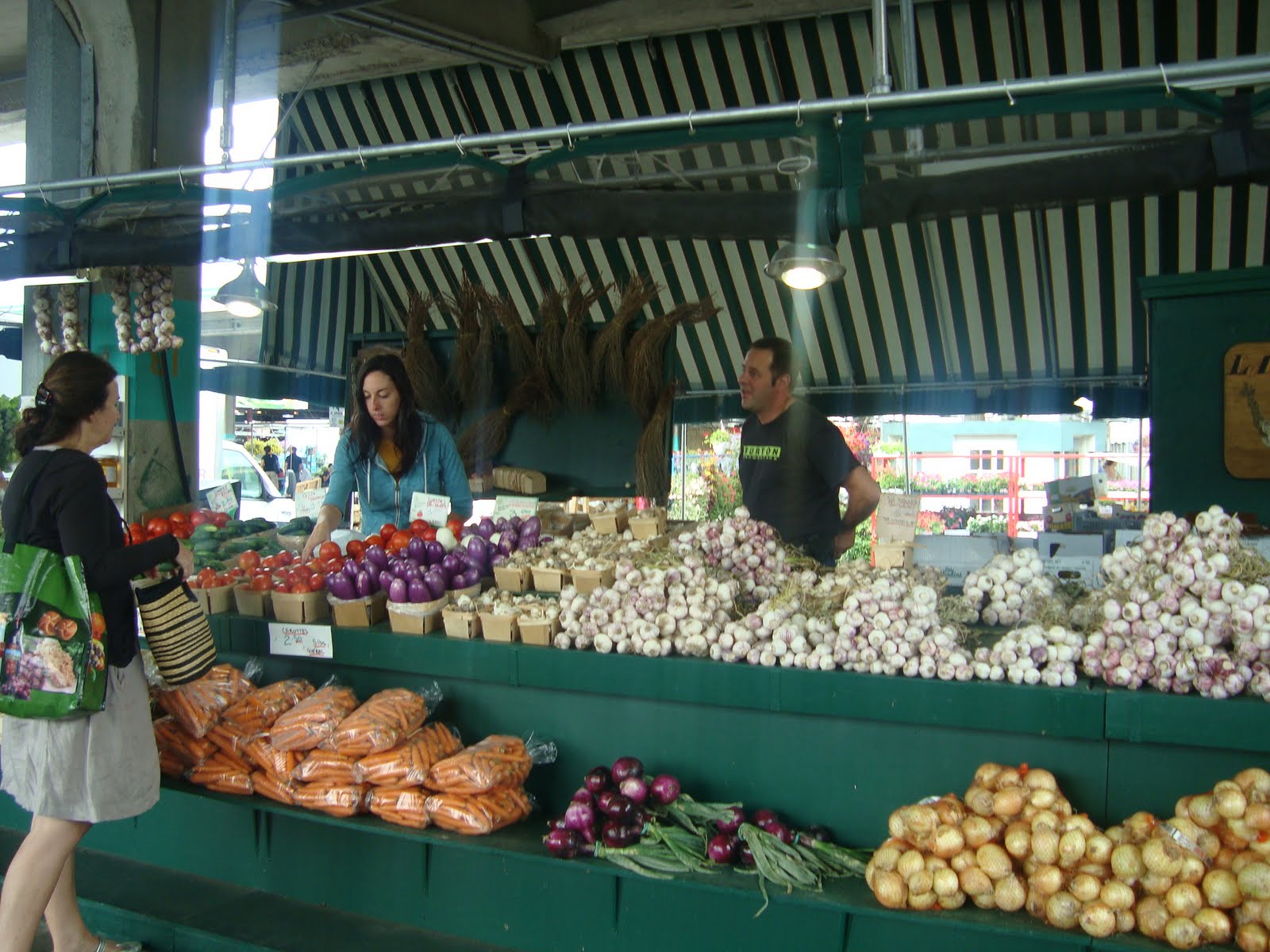

As for the produce, I generally avoid the biggest stalls, which usually have big signs and aggressively promote themselves, because they are the ones that do not sell local, in season produce. By now, I have several favourite stalls where I make most of my purchases, but part of my routine is to walk past all the market stalls to see what is available before I go around a second time and buy my supplies. Some vendors have organic produce, but even the non-organic produce is generally of high quality. Pictured below is one of my favourite stalls. They are pretty much a farm stand in the summer, but in the winter they do sell a small selection of imported produce.
La Ferme des Moissons. I have gotten to know the man on the right, who runs the stall. Sometimes he'll give me a discount for large purchases, another benefit of being a market regular


Atwater market has much less appeal to me, especially where produce is concerned. First, it is a smaller market with less variety and can sometimes be more crowded because it is closer to downtown. The prices of everything there are much more expensive. Still, there are some reasons to go to this market. Inside the market building you will find an amazing selection of high quality butcher shops. Top grade organic beef, lamb from Kamouraska, Québec, locally produced foie gras and other excellent meat can be found. The price is on the high side, but it is not excessive given the quality. There are also gourmet food shops, one of which is my preferred store for truffle oil. Notice that the items I prefer to buy here are high-priced anywhere you buy them. Cheaper products can be found elsewhere for a better price.


Stay tuned as my next post will discuss the importance of the farmers market in a more general sense.

Saturday, July 31, 2010

My Montreal - Mount Royal

This is the first post of a multi-part series about my favourite places in my hometown of Montreal, Quebec, Canada. Now that we have beautiful summer weather I have decided to use my days off of work to be a tourist in my own city. The difference is that I already know where most of my favourite places are, though I’m always open to finding new sights and new things to do. Today I will be featuring perhaps my favourite place in the city, Mount Royal.

The city of Montreal is on an island in the middle of the St. Laurence river and Mount Royal is in the centre of the island. In the early years of Montreal, the richest of the rich built homes on the slopes of the mountain and some of these historic buildings are still there to this day. Later, large sections of the mountain were purchased and turned into two very large cemeteries. In the late 19th century, the summit and much of the upper slopes of the mountain were converted into a public park, open to all free of charge. It was designed by Frederick Law Olmstead, the most accomplished landscape architect of the day who designed, among other projects, Central Park in New York. It is an amazing natural area with plenty of trails, some paved, some gravel, and some just earthen trails which go deeper into the wooded areas. It is also an oasis that is free of development yet located in the heart of the city. You can get up to the mountain by car or by bus, but my favourite way is to walk up, even from the heart of downtown.


View Larger Map

A quick note on directionals. In Montreal, the directions we refer to as north, south east and west do not correctly correspond to compass points. As far as directions on the mountain are concerned, west is south, east is north, and so on. I will try to describe directions as they are on the map.

Since I live to the west of the mountain(south on the map), I enter the park from that side and will describe it travelling in that direction. The first important location is Beaver Lake. I would say that this is without a doubt my single favourite place in Montreal. My parents were born in Montreal and, when I was growing up, we would travel to Montreal every year to visit my grandmother. Back then, one of our favourite places to go was Beaver Lake. We would drive up and find a bench on the shady side of the lake and just sit and watch the waterfowl and the people walking by. My grandmother has now passed on and this is one of the places where I have memories of spending time with her. But primarily I go there for peaceful tranquillity. This means I normally go during the week and often not in the height of summer, though I was back there recently. My favourite time to be at the lake is in early Spring. I walk up on one of the first days warm enough to spend a few hours outside after a long winter. There is usually snow still on the ground and the ice on the lake is just beginning to break up. That time of year it is usually deserted and very peaceful. Every time I go to the lake, I will slowly walk the entire path around the lake, then find a bench to sit down for a while and just enjoy my environment. A trip to the mountain is unthinkable for me without a stop at Beaver Lake. There are lots of activities there as well. There are paddle boats in the summer and ice skating and tobogganing in the winter.


Another must-see location is the chalet lookout, also called the Kondiaronk Belvedere. This is close to the centre of the park and offers a dramatic panoramic view of downtown Montreal and across the river to the towns on the “South Shore”. You can even see out to La Ronde, the Six Flags amusement park located on Ile Ste.-Helene, site of Expo 67, the global exposition considered to be the watershed moment for Montreal’s emergence as a world-class city. On the way to the chalet is Smith House which is a small café, gift shop, and museum with information about Mount Royal.


At the far side of the chalet, there is a downhill path leading to a long staircase. This leads you down the slope to a serpentine path that will eventually end at Peel street, a street that will take you into the heart of downtown. Along the way is a sight I only discovered on my most recent visit, just this week. It is the “Give Peace a Chance” monument, an arrangement of stone slabs that say “Give Peace a Chance” in 40 different languages. It is in fact an art installation created last year in honour of the 40th anniversary of the “bed-in for peace” held by John Lennon and Yoko Ono and their writing of the song “Give Peace a Chance” at the Queen Elizabeth Hotel in Montreal in 1969.


Continuing north past the chalet you approach the summit area. There is very little to mark the actual summit. There is a communication tower in a clearing surrounded by trees, providing no sightlines or photo opportunities. Nearby is the famous metal cross that is lit up at night and defines the mountain’s skyline. A few hundred yards away is the actual summit, though there is not much in the way of markings. From the summit you can follow a trail which will lead you to a staircase where you begin descending the other side of the mountain. At the bottom of the staircase there is a road and parking area that features another scenic lookout. This is the Camilien-Houde overlook and from here you can see off to the east end of the city(actually to the north). The massive object dominating the skyline is the infamous Olympic Stadium, built for the Summer Olympics of 1976, yet already crumbling. The major league baseball team that used to play there left years ago and the football team plays here on the mountain, making the stadium one of the best examples of a white elephant (it even kind of looks like a white elephant!) known to modern construction.

Obviously this was not taken from the lookout, but right next to the stadium


At the far end of the lookout parking lot is a hard-to-see spur trail that comes off the road and turns back underneath the overlook. This is my favourite path to descend the east(north) side of the mountain. The paths are not marked here but if you stay on heavily used trails and keep going downhill you should be OK. You should eventually cross the Olmstead trail a wider marked path along the way. The destination is the base of the mountain at the Georges-Etienne Cartier Monument on Parc Avenue. If you do not want to risk these smaller unmarked trails, you can follow Olmstead trail all the way. To get there take the staircase down from the chalet as described above then, instead of going down the serpentine path to Peel street, turn left and follow this path all the way to the monument. There are also smaller trails that come off of Olmstead Trail at various points that also lead there. I could not possibly describe all the possible routes and sites there are to see. The map above was the best I could find to put directly into the post. For more detail I strongly recommend the interactive map at Les Amis De La Montagne. It can be very helpful to orient yourself and make sense of all this. If you do decide to explore the smaller, less marked trails, a GPS can be very useful, since it is hard to get too far lost as long as you are headed in the right general direction.

Amis De La Montagne Interactive Map: http://www.lemontroyal.qc.ca/carte/en/index.sn


If you think you are going to see all these things at once on a single day outing to the mountain, think again. This place is HUGE so a lot of walking is involved, especially to get to places further from the road. For a one day outing I suggest going to Beaver Lake and the chalet. If you like it and want to come back again, that is the time to start exploring a little more.

Can you tell I really, really like this place? In future posts I will describe some of my other favourite places in Montreal, some famous, some almost unkown.